0
0

KARACHI: The outgoing week began with the KSE-100 index staying in the red zone on the back of investors’ concerns over geopolitical tensions between Russia and Ukraine.
The military conflict in Eastern Europe pushed global crude oil prices above the level of $100 per barrel. Other factors, like the Financial Action Task Force’s decision on Pakistan’s status along with the selling spree during the rollover week, also kept the index under pressure, according to Arif Habib Ltd.
The announcement about the incentives worth Rs1 billion for the IT sector triggered buying mid-week. However, the positive momentum couldn’t sustain for long as the market plummeted on Russia’s attack on Ukraine.
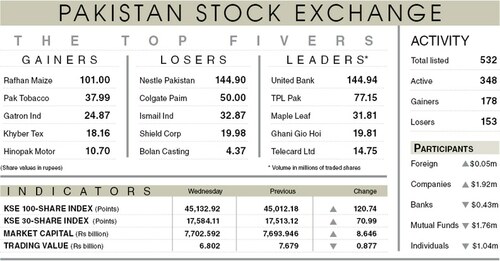
As a result, the stock market closed at 43,984 points, shedding 1,692 points or 3.7 per cent from the preceding week.
Sector-wise, negative contributions to the index came from technology and communication (342 points), commercial banking (243 points), cement (222 points), oil and gas exploration companies (146 points) and fertiliser (127 points).
Sectors that contributed positively were automobile assembling (18 points), real estate investment trusts (10 points) and tobacco (nine points).
Scrip-wise, negative contributors were TRG Pakistan Ltd (201 points), Lucky Cement Ltd (133 points), Systems Ltd (109 points), Habib Bank Ltd (100 points) and Pakistan Petroleum Ltd (76 points).
Positive contributors to the benchmark were United Bank Ltd (46 points), Millat Tractors Ltd (23 points) and Habib Metropolitan Bank Ltd (16 points). Foreign selling continued in the outgoing week and clocked in at $3.2 million versus a net sell of $1.97m a week ago. Major selling was witnessed in cement ($2.1m) and technology ($1.7m).
On the local front, buying was reported by banks ($0.6m). The average daily volume was 229m shares, up 20pc from the preceding week. The average daily value traded settled at $38m after going up 29pc on a week-on-week basis.
According to AKD Securities, the rally in global commodities has brought the local currency under pressure as the national import bill inches up. “For every $5 change in oil prices, Pakistan’s [current account deficit] rises by $1.2bn,” it said, adding that sectors like cement may remain under pressure in the near term owing to the escalation in energy prices.
Supply chain disruptions for metals and semiconductors may also hinder the ability of the automobile sector to deliver its products on time, it noted.
“We expect Mughal Iron and Steel Industries Ltd in the steel sector to actually benefit from the exports of copper at a higher prevailing price. In terms of valuations, the market remains extremely attractive, providing a huge opportunity to take exposure in value stocks,” the brokerage said.
Published in Dawn, February 27th, 2022