Shaukat Tarin stresses need for hike in savings rates, tax-to-GDP ratio


 4
4


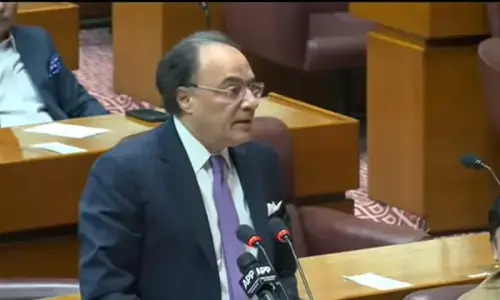
ISLAMABAD: Finance Minister Shaukat Tarin has cautioned that Pakistan would not be able to achieve sustainable economic growth and surpass the figure of four per cent growth rate unless savings rates and tax-to-GDP growth are enhanced.
Speaking at a workshop on industrial policy formulation here on Thursday, he said that the rate of savings which is currently around 15pc, should be increased to 25pc, while the tax-to-GDP ratio needs to be enhanced from current 10pc to 20pc.
Mr Tarin said that the government was focusing on improving the savings rate, for which it was using technology to increase revenue mobilisation. At the same time, strategy has to be developed for investment in information technology, tourism and exports, he said.
The finance minister was confident that the government would be able to achieve GDP growth rate between 4.5pc and 5pc during the current financial year, which reflects that the government is on the trajectory of sustainable growth.
Govt starts process of formulating a ‘national industrial policy’
He said that the gap between imports and exports is quite big — as high as $40 billion — and this has to be brought down in order to reduce the current account deficit.
Mr Tarin discussed historical background of deindustrialisation in Pakistan, and emphasised on the diversification of exportable basket and increasing manufacturing as well as agriculture output to take the country out of chronic issue pertaining balance of payments.
The government has started the process of formulating a ‘national industrial policy’ to promote inclusive and sustainable industrial development for exports and investment, blaming previous governments for their incoherent economic policies that led towards declined manufacturing base and proved detrimental to job creation in the country over the years.
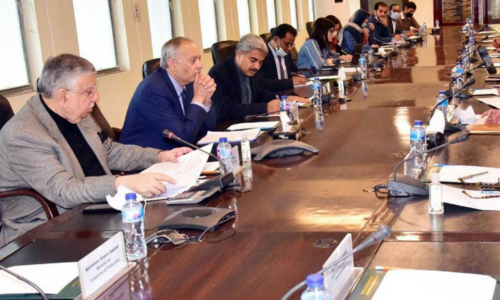
To kickstart formulation of the policy, the ministry of industries and production held a workshop in Islamabad on Thursday to develop inter-ministerial synergy for the policy with a view to promoting inclusive and sustainable industrial development and shape a collective vision for sustainable economic growth in Pakistan. The workshop was held in partnership with the Revenue Mobilisation, Investment and Trade Programme and UK Aid.
Minister for Industries and Production Khusro Bakhtyar said that the successful policy initiatives launched by the PTI government during the past three years to promote domestic production, exports and to generate employment are seen as a major positivity for Pakistan.
“Our main focus while developing the new policy is job creation and productivity enhancement which will help in improving economic growth and social stability in Pakistan,” he said.
Mr Bakhtyar said that the localisation of auto parts has increased to 45pc and the government is aiming to increase it up to 65pc in coming years. Similarly, local manufacturing of mobiles has resulted in production of 22.12 million phones within the first year of regime introduction.
The minister also highlighted the salient features of national SME policy to provide much-needed support to SMEs across the country.
The industrialisation process has started in Pakistan with the development of industrial zones, industrial corridors, SEZs and different value-chains, Mr Bakhtyar emphasised, adding that the recent approach of creating manufacturing-based industrial parks across the country and allocation of lands on the basis of plug-and-play model would boost the manufacturing sector of Pakistan.
The workshop was also addressed by Adviser to the Prime Minister on Climate Change Amin Aslam, Chairman of the Board of Investment Azfar Ahsan and Deputy Chairman of the Planning Commission Jahanzeb Khan.
Mr Aslam underlined the importance of introducing green technology and energy efficiencies in the manufacturing sector, while Jahanzeb Khan highlighted the key areas of three years of rolling growth plan focusing on job-intensive growth approach.
Published in Dawn, February 25th, 2022