Altaf Hussain spoke of ‘total war’ for Muhajir rights, jury told


 51
51


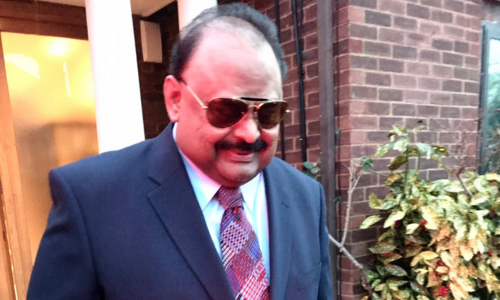
LONDON: Nichola Khan — a social anthropologist and lecturer at Brighton University who has written extensively on Muhajir politics — on Friday gave testimony as an expert witness before the jury in the ‘hate speech’ trial of Muttahida Qaumi Movement (MQM) supremo Altaf Hussain.
Dr Khan said the MQM did not just have political and charity wings but also a militant wing, which the party did not acknowledge. She added the party’s workers were “subjected to extrajudicial killings at the hands of Rangers, who violated human rights”, to establish peace in Karachi.
She said Mr Hussain had spoken of “meeting violence with violence” and a total war for Muhajir rights.
Dr Khan also said the MQM was able to totally shut down Karachi to the extent that it would be dangerous to travel on roads. However, after a Rangers operation in the city, MQM’s power had been much diminished by 2016.
Dr Nichola Khan explains political history of MQM, its founder
Dr Khan produced a written report on the MQM for the court and was cross-examined by both the prosecution and defence teams.
The jury heard that given her research and writing on the MQM, Dr Khan had significant understanding of the matters to be discussed during the trial.
Dr Khan said she has been conducting research into issues of violence in Pakistan for about 20 years and has also written a book called Mohajir Militancy in Pakistan.
She spoke at length about the independence of India and Pakistan, and about Muhajir settlements in the city of Karachi. She said the MQM started off as a student organisation which later evolved into a political party.
About Mr Hussain, Dr Khan said that even after he left Pakistan and moved to the UK in the 90s, he had “absolute control over the party”. She described how MQM would call days of protest and mourning and that Mr Hussain’s control was not relinquished despite his departure from Karachi.
“After the [August 22] speech, the two TV stations, ARY and Samaa, were attacked. There was gunfire,” she said, adding: “One MQM worker was killed in the violence, allegedly by the police.”
Mr Hussain has been charged under section 1(2) of the British Terrorism Act (TACT) 2006, which relates to the encouragement of terrorism, which is defined as being intentional or reckless as to whether members of the public will be directly or indirectly encouraged or otherwise induced by the statement to commit, prepare or instigate such acts or offences.
Mr Hussain has pleaded not guilty, and in police interviews, maintained that he has not committed any offence.
The hearing was adjourned in the afternoon and will resume on Monday morning at the Kingston-upon-Thames crown court.
Published in Dawn, February 5th, 2022