



 0
0

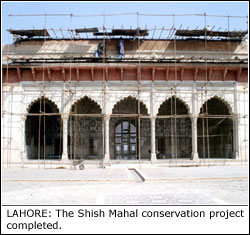 LAHORE, Nov 24: The roof of the historic Shish Mahal has been stabilized for at least 100 years, says Richard Hughes, a heritage conservationist from the UK. Work on preservation of Shish Mahal, which was initiated more than two years ago, has completed this month.
A team of foreign and national experts, headed by Mr Hughes, is currently visiting the fort to inspect the preservation of the Mughal-era architecture. It includes Unesco’s programme specialist for culture Junko Taniguchi, consultant for culture Dr Pamela Rogers, Norway’s cultural heritage director Lyder Marstrander and Unesco’s Farhat Gul.
Mr Hughes told Dawn on Thursday that conservation had been done according to the recommendations of the experts. “It has been preserved in a very delicate manner and no major conservation of the roof will be required for years to come.”
Replying to questions, he said the scaffolding was fixed not to provide support to the roof but for carrying out cleaning work. He said it would be up to the government whether or not to open the Shish Mahal chambers to visitors. However, being an expert, he did not recommend it as it might add to its decay.
Unesco had secured a grant of about US $900,000 from the Norwegian government in 2003 for the conservation of Shish Mahal, preparation of a master plan and scientific study of the fort.
Situated in the northwest corner of the fort, Shish Mahal is one of the most profusely decorated places of the Mughal period. Built by Asif Khan for Emperor Shah Jehan in 1631-32, it formed the harem of the fort.
It had started crumbling in the early 1990s owing to rainwater seepage. The department concerned had then installed a specially-designed angle iron structure over the roof to harbour the rotten wooden truss of Shish Mahal.
The foreign and national archaeologists engaged in its preservation had carried out the documentation of cement mortar, analysis of the existing rainwater drainage system and structural analysis.
The work on stucco tracery, cleaning of marble and mirrors, and termite eradication of the Mughal-period timber beams has also been completed. A 1,700-foot long Norwegian mesh has also been laid to provide a support to the sagging ceiling.
While applying gypsum mortar, gaps have been created to allow inspection in case there is any de-bonding of the new and old layers. Restoration of aiynakari (mirror work) will continue.
Federal Archaeology Department senior architect and conservation coordinator Maqsood Ahmad said it was a role model project ever done in the history of Pakistan. He said the project could not be materialized without the financial support of the Norwegian government.



























