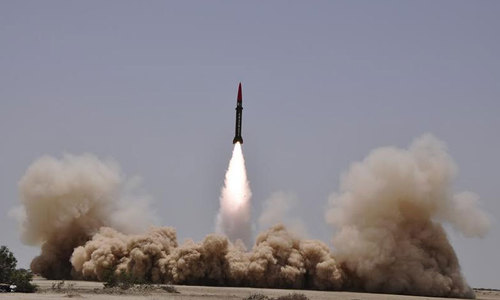
PARIS: Five global nuclear powers pledged on Monday to prevent atomic weapons spreading and to avoid nuclear conflict, in a rare joint statement setting aside rising West-East tensions to reaffirm a goal of a nuke-free world.
“We believe strongly that the further spread of such weapons must be prevented,” said permanent UN Security Council members China, France, Russia, the UK and United States, adding: “A nuclear war cannot be won and must never be fought.”
The statement was issued after the latest review of the Treaty on the Non-Proliferation of Nuclear Weapons (NPT) — which first came into force in 1970 — was postponed from its scheduled date of January 4 to later in the year due to the Covid-19 pandemic.
Putting aside current differences that have caused major tensions between both China and Russia and their Western partners, the five world powers said they saw “the avoidance of war between nuclear-weapon states and the reduction of strategic risks as our foremost responsibilities.” “As nuclear use would have far-reaching consequences, we also affirm that nuclear weapons — for as long as they continue to exist — should serve defensive purposes, deter aggression, and prevent war,” they said according to the English text released by the White House.
The powers added: “We each intend to maintain and further strengthen our national measures to prevent unauthorised or unintended use of nuclear weapons.” The statement also contained a pledge to abide by a key article in the NPT under which states committed to full nuclear disarmament in the future.
“We remain committed to our NPT obligations, including our Article 6 obligation” on a treaty on general and complete disarmament under strict control. According to the UN, a total of 191 states have joined the treaty. The provisions of the treaty call for a review of its operation every five years.
The statement comes as tensions between Russia and the United States have reached heights rarely seen since the Cold War over a troop build-up by Moscow close to the Ukrainian border.
That has raised fears that the Kremlin, worried by the possibility of further eastward expansion of NATO, is planning a new attack on its pro-Western neighbour. Crunch talks between Russia and the US on European security are expected in Geneva on January 10.
The rise of China meanwhile under President Xi Jinping has also raised concerns that tensions with Washington could lead to conflict, notably over the island of Taiwan.
Beijing considers Taiwan part of its territory and has vowed to one day seize it, by force if necessary. Russia welcomed the declaration by the atomic powers and expressed hope it would reduce global tensions.
“We hope that, in the current difficult conditions of international security, the approval of such a political statement will help reduce the level of international tensions,” the Russian foreign ministry said in a statement.
Kremlin spokesman Dmitry Peskov told the RIA Novosti news agency that Moscow still considered a summit between the world’s nuclear powers to be “necessary”.
Published in Dawn, January 4th, 2022