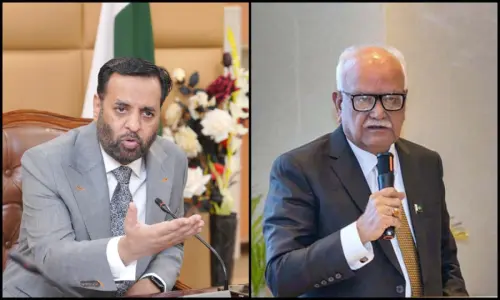
KARACHI: Members of the provincial parliamentary task force on sustainable development goals (SDGs) on Wednesday expressed serious concern over the non-functioning of effluent treatment plants in the entire province.
Speaking at a meeting of the task force at the Sindh Assembly building, they also emphasised the need for measures to control the leakage of methane gas from LNG terminals around Karachi coast.
Sindh Environmental Protection Agency (Sepa) Director General Naeem Ahmed Mughal informed the meeting that an estimated 470 million gallons per day (mgd) industrial and municipal waste from Karachi was directly disposed of into the sea without any treatment.
Of the 470mgd waste, 80 per cent was sewage and 20pc was industrial waste.
Sepa chief informs task force on SDGs that city’s 470mgd industrial, municipal waste directly released into sea
Mr Mughal told the meeting that the government planned to install seven combined effluent treatment plants (CETP) in the city’s industrial zones, but none of them was working.
“The Karachi Water and Sewerage Board (KWSB) is the implementation agency for CETP and Sepa has a regulatory role,” he said.
He expressed concerns over the situation in other major cities of Sindh where, he said, industrial and municipal waste was directly discharged into the Indus river or its canals.
He pointed out that all municipal and industrial sewage from Hyderabad was directly disposed of into Phuleli Canal without any treatment.
“The industrial effluent from the industries of Kotri is discharged into KB Feeder, which supplies drinking water to Karachi via Keenjhar Lake,” he said.
He said that Sepa closed down a cement factory in the Nooriabad industrial area for two months and only allowed it to operate when the management installed an air treatment plant.
He maintained that Sepa was trying to implement the Sindh Environmental Quality Standards (SEQS) and had closed down many industries, which were non-compliant to the standards.
“During the last three years, 209 treatment plants have been installed in the industries in Karachi, and 50 more water treatment plants are being installed,” he added.
The Sepa chief was also asked by the chairman of the task force to give a detailed briefing to other members of the assembly.
Pakistan most vulnerable to climate change
In another presentation, environmental expert Nasir Panhwar said that Pakistan was fifth most vulnerable country to climate change, water scarcity and extreme events in particular.
According to Mr Panhwar, damages and losses resulting from natural disasters in Pakistan over the past decade had exceeded $10 billion.
“Sindh is facing environmental challenges due to climate change,” he said, adding that the sea level along Karachi coast had risen approximately 10 centimetres in the last century and was expected to further rise by 60cm by the end of the century.
He said that low-lying coastal areas in Indus Delta were facing sea intrusion, which destroyed millions of acres of the land.
He said a climate change policy had been drafted, but was waiting for the approval.
Director of The Knowledge Forum Zeenia Shaukat said that about 80pc of the country’s energy came from fossil fuel-based means, and very little attention has been paid to generate energy from renewables.
She pointed out that persistent events such as heatwaves, regular flash floods, reduction in water resources and dwindling agriculture resources emphasised the need for stronger institutional action on climate change.
Another environmental expert, Jameel Junejo, said that due to the shortage of natural gas in the country, the government was developing Liquefied Natural Gas (LNG) terminals to supply gas via pipes to different parts of the country.
“Two LNG terminals have been developed and five are under construction. LNG is considered an environmentally safe fuel, but when it is handled and converted from liquid shape to gas for supply through pipes, methane gas is leaked which is dangerous for the environment. Methane gas leakage is more dangerous for the environment and human health than the emission coming out from other fossil fuel plants,” he said.
“In the energy mix, Pakistan is producing only three per cent of energy from renewables, whereas at least 30pc of energy should be produced from renewable,” he said.
The meeting was attended by task force chairman Pir Mujeeb ul Haque, MPAs Saeed Afridi, Farhat Seemi, Kalsoom Chandio, Shahzad Qureshi, Arsalan Taj Ghumman, Ghazala Siyal and Heer Soho.
Published in Dawn, December 23rd, 2021