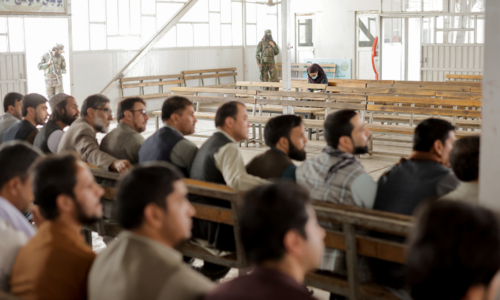
Taliban govt resumes issuing Afghan passports in Kabul

KABUL: Afghanistan’s Taliban authorities said on Saturday they will resume issuing passports in Kabul, giving hope to citizens who feel threatened living under their rule.
Thousands of Afghans have applied for new travel documents to escape a growing economic as well as a humanitarian crisis described by the United Nations as an “avalanche of hunger”.
Authorities will start issuing the documents from Sunday at Kabul’s passport office, Alam Gul Haqqani, the head of the passport department in the interior ministry, told reporters.
The Taliban stopped issuing passports shortly after their August 15 return to power, as tens of thousands of people scrambled to Kabul’s only airport in a bid to catch any international flight that could evacuate them.
In October, authorities reopened the passport office in Kabul only to suspend work days later as a flood of applications caused the biometric equipment to break down.
“All the technical issues have now been resolved,” Haqqani said, adding that initially travel documents will be given to those who had already applied before the office suspended work. New applications will be accepted from January 10.
Many Afghans who wanted to visit neighbouring Pakistan for medical treatment have also been blocked in the absence of valid passports.
“My mother has some health issues and we needed to go to Pakistan a long time ago, but we could not because the passport department was closed,” said Jamshid, who like many Afghans goes by only one name.
“We are happy now ... we can get our passports and go to Pakistan,” he said as many began gathering outside the passport office after Saturday’s announcement.
Issuing passports — and allowing people to leave amid the growing humanitarian crisis — is seen as a test of the Taliban’s commitment to the international community.
The Taliban are pressing donors to restore billions of dollars in aid that was suspended when the previous Western-backed regime imploded in the final stages of a US military withdrawal.
The abrupt withholding of aid has amounted to an “unprecedented” fiscal shock for an economy already battered by drought and decades of war, according to the United Nations Development Programme.
The crisis has forced many to sell household possessions to buy food.
On Saturday, the Taliban government’s deputy foreign minister Sher Mohammad Abbas Stanekzai urged aid agencies to apply pressure for the release of nearly $10 billion worth of assets held in the United States.
Stanekzai also urged all Afghan refugees to return now that the war had ended.
“We invite and encourage everyone to return to Afghanistan, even our political opponents,” he said at a function held to mark International Migrants Day.
Afghanistan’s minister for refugees Khalil Haqqani said that humanitarian organisations must help Afghan refugees return home.
“Afghan refugees living in camps abroad are in a bad situation. They have to return to Afghanistan and work here,” said Haqqani, who is a member of the Haqqani network, which was branded a terror group by Washington.
Over the past four decades, more than six million Afghans have fled the country to escape war and economic crises, most of them living in neighbouring Iran and Pakistan.
The international community has so far not recognised the current Taliban government that was formed after the chaotic withdrawal of US-led foreign troops.
International flights, mainly to Dubai and Abu Dhabi, have meanwhile slowly resumed at Kabul airport after the facility was trashed in August when crowds of people scrambled to evacuate.
Published in Dawn, December 19th, 2021