UK probes bias in medical devices after high Covid toll among Blacks, Asians

LONDON: The British government is investigating whether built-in racial bias in some medical devices led to Black and Asian people getting sick and dying disproportionately from Covid-19.
Health Secretary Sajid Javid said on Sunday that the pandemic had highlighted health disparities along race and gender lines. He said that a third of intensive care admissions in Britain at the height of the pandemic were people from Black and ethnic minority backgrounds, more than double their share of the population.
Britain’s statistics office has found that in the first year of the pandemic, up to March 2021, Black and South Asian people in the UK had higher death rates than their white compatriots, even after factors like occupation and underlying health conditions were taken into account.
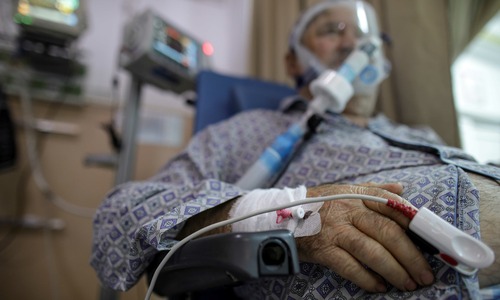
Javid said one issue was research showing that pulse oximeters, which measure blood oxygen levels through the skin, work less well on darker skin. He called it a systemic worldwide issue.
“Now, I’m not saying this was deliberate by anyone, I think it’s just, it’s a systemic issue potentially, with medical devices and it may go even further than that with medical textbooks, for example,” Javid told Sky News.
Writing in the Sunday Times, he said the possibility that a bias, even an inadvertent one, could lead to a poorer health outcome, was totally unacceptable.
He said he hoped to work with his US counterpart, Health and Human Services Secretary Xavier Becerra, and officials in other countries, to eliminate bias in the health system.
He said a UK review, which would also look at gender bias, would report its findings by the end of January.
Britain has recorded more than 143,000 coronavirus deaths, the highest total in Europe after Russia.
Europe is currently the only part of the world where Covid-19 cases are rising, and many countries are reintroducing restrictions to fight the surge. Austria will enter a nationwide lockdown on Monday (today), and violent protests erupted in the Netherlands this weekend after the government said it would restrict access for unvaccinated people to some venues.
In the UK, however, cases are broadly flat and deaths and hospitalisations are slowly declining. Prime Minister Boris Johnson said this week that he saw no need to move to the government’s winter Plan B, in which people would be required to wear masks indoors and advised to work from home.
Britain had higher infection rates than its neighbours for several months, and some scientists say that puts the country in a better position now.
Linda Bauld, a professor of public health at the University of Edinburgh, said the UK had been dealing with the highly transmissible delta variant of the virus longer than its European neighbours, and “because we’ve had high infections in the past, we’ve probably a bit more natural immunity in the population. Britain is also now rolling out booster vaccine doses to everyone 40 and up”.
Oxford University professor of medicine John Bell said he didn’t think the UK would face another Christmas lockdown, as it did last year.
“My advice is, order that turkey, because it’ll all be fine,” he told Times Radio. But, he added, “if you’re planning a skiing holiday in Austria, things may not go so well”.
Published in Dawn, November 22nd, 2021