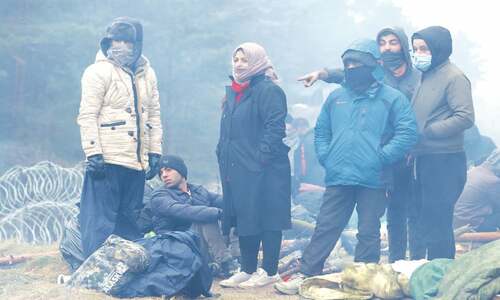
Poland says Belarus has changed tactics on migrant crisis


HAJNOWKA: Poland said on Saturday that Belarus has changed tactics in their border crisis by directing smaller groups of migrants to several points along the European Union’s eastern frontier.
Though there have been signs of the crisis easing, Defence Minister Mariusz Blaszczak said he expected the border showdown to be long drawn out while Belarus said the situation remained “tense”.
Polish border guards reported new attempted crossings by several groups mostly consisting of dozens of migrants, though also including one crowd of 200 people hurling rocks and using tear gas.
“We have to prepare for the fact that this problem will continue for months. I have no doubt that that will be the case,” Blaszczak told RMF FM radio.
“Now a bit of a new method has been taken on by the migrants and Belarusian services... Smaller groups of people are trying to cross the border in many places.”
He added that “there is no question that these attacks are directed by Belarusian services.” The West accuses Belarus of artificially creating the crisis by bringing in would-be migrants — mostly from the Middle East — and taking them to the border with promises of an easy crossing into the European Union.
Belarus has denied the claim, instead criticising the EU for not taking in the migrants.
Belarusian President Alexander Lukashenko told the BBC on Friday that it was “absolutely possible” his forces had helped people cross into the EU but denied orchestrating the operation.
“We’re Slavs. We have hearts. Our troops know the migrants are going to Germany... Maybe someone helped them,” he said. “But I didn’t invite them here.”
The migrants have abandoned everything in their countries, spending thousands of dollars to fly into Belarus on tourist visas, determined to reach the EU. There were indications this week that the crisis was abating after several hundred migrants were repatriated to Iraq, while 2,000 others left a makeshift border encampment for a nearby logistics centre.
Muluseu Mamo, a representative of the United Nations refugee agency in Belarus, visited the centre Saturday, saying that while conditions there were better than in the forest, “much is missing”.
“If you ask if these are good conditions for further living, I would say no,” he was quoted by Russian state news agency RIA Novosti as telling reporters, adding that migrants there have complained about a lack of food, clothing and medical services.
Also Saturday, the Belarusian health ministry said that a World Health Organisation mission had arrived in Belarus to help organise medical support for the migrants.
Yemen’s foreign ministry said Saturday that it was working on bringing back its citizens from the border, including eight on the Belarusian side and nine in Poland. Polish border guards said that on Friday there had been 195 attempted illegal crossings, with 82 migrants ordered to leave Poland.
“The largest group consisted of around 200 foreigners, the others each numbered several dozen,” the guards tweeted on Saturday. “The foreigners were aggressive — they threw rocks, firecrackers and used tear gas.”
The Belarusian state border committee, meanwhile, said that “the situation on the border remains tense”.
“Attempts to violently and brutally expel refugees from the territories of neighbouring EU member states continue,” the committee said on its Telegram channel.
Published in Dawn, November 21st, 2021