Punjab govt approaches apex court against LHC's order to release Saad Rizvi



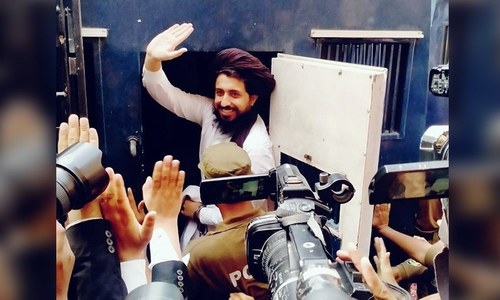
The Punjab government approached the Supreme Court on Monday, challenging the Lahore High Court’s (LHC) order declaring the detention of TLP chief Saad Hussain Rizvi (TLP), illegal.
The LHC had on Oct 1 declared illegal the detention of Rizvi in response to a plea filed by Rizvi's uncle against his continued incarceration. Subsequently, the Lahore deputy commissioner had also issued orders for Rizvi's release, citing the LHC judgement. The orders have, however, yet to be complied with and Rizvi is still in custody.
In addition, the DC's order had referred to two earlier decisions taken by the federal review board of the Supreme Court (SC) with regards to Rizvi's detention.
On July 2, a review board of the LHC had rejected the Punjab Home Department's request to extend Rizvi's detention under the Maintenance of Public Order (MPO) Ordinance, 1960. It had released its detailed order in the case on July 8, observing that Rizvi should be "released forthwith" if he was not required in any other case.
Subsequently, Rizvi's uncle had filed a petition calling for the annulment of his “illegal detention” and claiming that there was no proof on record against him.
Rizvi's detention was supposed to end on July 10 in light of the review board's decision. However, the deputy commissioner of Lahore issued a fresh notification under Section 11-EEE (Powers to arrest and detain suspected persons) of the Anti-Terrorism Act 1997 and detained Rizvi for 90 days.
Hussain subsequently filed another petition on Aug 2 with the LHC, claiming that the government had extended Rizvi's detention with "mala fide intention". The petitioner said the government had implicated Rizvi in 14 criminal cases after detaining him.
He asked the court to declare the act of the government illegal and order his nephew's release. The court had on Aug 17 sought replies from the authorities on the plea before declaring his detention illegal in a subsequent hearing at the start of this month.
Months-long detention
Rizvi was detained by police under the MPO ordinance on April 12 over charges that he had incited his followers to take the law into their hands as, according to him, the government had reneged on its promise to expel the French ambassador.
The party had been pressing the government for the expulsion of the French envoy to Pakistan ever since blasphemous caricatures of Prophet Muhammad (PBUH) were published in France and their publication was supported by the French president.
Challenging the LHC decision in the apex court today, the Punjab government argued in its petition that legal requirements were not met in the LHC's direction, paving the way for the TLP chief's release.
The provincial government has made Rizvi's uncle a respondent in the petition.
The plea said there were reports by intelligence agencies that Rizvi's continued detention was necessary to prevent workers of the proscribed organisation to create a law and order situation.
"There is credible information that hardliners within TLP are planning to stage sabotage activities as they are waiting for the release of detenue," the petition added.
The provincial government urged the top court to set aside the Oct 1 order of the LHC and let authorities continue the detention of the TLP chief.
The court fixed October 12 (tomorrow) for hearing the petition.
Rizvi's arrest and TLP protests
In November 2020, an agreement was reached between the TLP and the government — after the party held protests in the capital led by its then chief and Saad's father, Khadim Rizvi — to involve the parliament in order to decide the matter of the French ambassador's expulsion in three months.
As the February 16 deadline neared, the government had expressed its inability to implement the agreement and had sought more time. The TLP had then agreed to delay its protest by two-and-a-half months to April 20.
A week before the deadline, Rizvi, in a video message, had asked TLP workers to be ready to launch a long march if the government failed to meet the deadline. The move had prompted the government to arrest him on April 12.
Police had swooped in on Rizvi at around 2pm on Wahdat Road in Lahore where he had gone to attend a funeral. Outraged, the TLP had issued a call for countrywide protests.
The next day, police registered a first information report against the TLP chief under sections of the Anti-Terrorism Act. Within the next few hours, protesters took to the streets in Lahore and blocked the Grand Trunk Road at a number of points.
The government had subsequently banned the TLP following the violent protests and sit-ins it staged across the country.