As multiple diseases spread, experts warn against polypharmacy


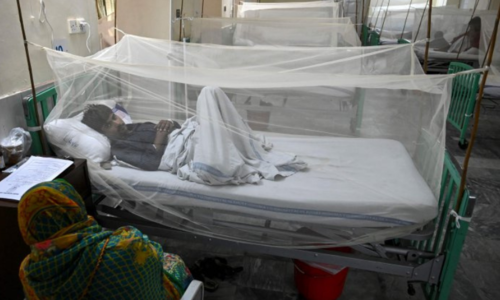
• Country witnessing outbreak of Covid, dengue, typhoid, malaria
• Doctors advised to diagnose disease on basis of symptoms, suggest tests
ISLAMABAD: As Covid-19, dengue, typhoid and malaria are all spreading at the same time, experts have advised people to avoid polypharmacy practice as it has serious side-effects and could lead to emergence of multi-drug resistant virus or bacteria.
On the other hand, the National Command and Operation Centre (NCOC) data showed that 35 patients succumbed to Covid-19 and 1,656 more people contracted the virus. The positivity ratio stood at 3.26 per cent while the number of active cases remained 46,503 as of Oct 3. A total of 3,604 patients were admitted to hospitals across the country.
Talking to Dawn, Member of the Scientific Task Force on Covid-19 Prof Dr Javed Akram said though Covid-19 had been controlled to a certain extent, emergence of dengue cases had complicated the situation.
“At the moment we have a number of infections, all spreading at the same time such as dengue, Covid-19, typhoid and malaria. Under this situation, health practitioners have started polypharmacy practice which not only causes severe side-effects but also leads to emergence of multi-drug resistant virus or bacteria,” he said.
Polypharmacy is defined as regular use of at least five medications — common in older adults and younger at-risk population – that increases the risk of adverse medical outcomes.
Dr Akram said Covid-19, dengue and typhoid showed similar symptoms due to which a number of physicians prescribe all medicines at the same time.
“A trained physician should be able to diagnose and identify the exact disease from symptoms or suggest tests rather than prescribe medicines. As dengue cases are increasing, people should also know that both upper and lower respiratory infections are common in dengue patients,” Dr Akram said, adding that at the moment dengue was mild to moderate but “we are entering the season when it will soon become endemic and cases of life-threatening dengue hemorrhagic fever will rise”.
Dengue is spread through a mosquito and a patient faces deficiency in platelets as a result of which transfusion is required. If timely treatment is not provided, the disease may turn into life-threatening hemorrhagic fever, which may lead to bleeding, low levels of platelets and blood plasma leakage, or dengue shock syndrome – a dangerously low blood pressure.
However, Dr Akram, who is also University of Health Sciences (UHS) vice chancellor, said according to a study blood or platelet transfusion should be avoided in dengue patients.
“Whenever the number of platelets reduces, thickness of blood increases automatically. So I suggest that transfusion of platelets should be avoided unless bleeding starts. I have personally observed a number of patients, whose platelet count fell but later it increased again without transfusion,” he added.
Dr Akram said typhoid resistant bacteria had already been diagnosed in Pakistan and could become a serious problem in a few years.
It is pertinent to mention here that in 2018, the American Centre for Disease Control and Prevention had issued an advisory on the outbreak of extensively drug-resistant (XDR) typhoid fever in Pakistan that did not respond to most antibiotics, which panicked national and international health circles. Since then it is being advised to stop irrational use of medicines.
Pakistan has experienced dengue outbreaks since 1994. In the last two decades, three major outbreaks were reported. Over 6,000 cases and 52 deaths were reported in 2005, more than 21,000 cases and 350 deaths in 2011 whereas 48,000 laboratory confirmed cases of dengue were reported from across the country between 2011 and 2014. In 2019, around 50,000 cases emerged in the country.
Published in Dawn, October 4th, 2021