Palestinian state 'best way' to resolve conflict with Israel, Biden says at UN
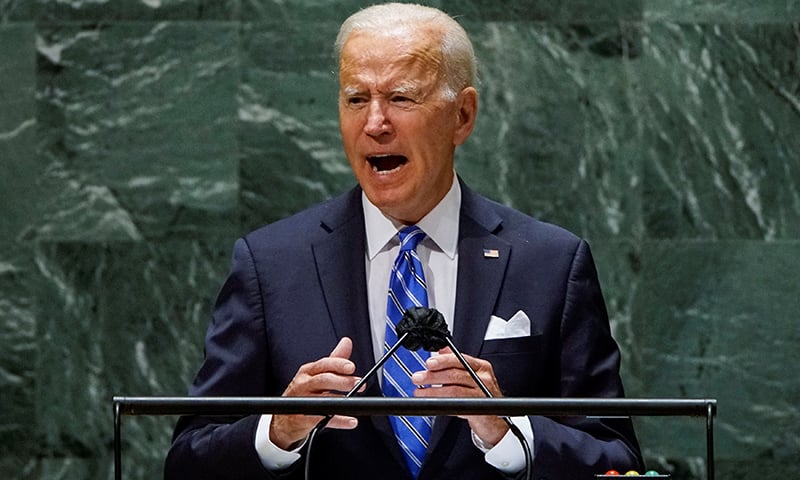

US President Joe Biden said on Tuesday that a sovereign and democratic Palestinian state is the “best way” to ensure Israel's future.
“We must seek a future of greater peace and security for all people of the Middle East,” Biden said in a speech to the UN General Assembly.
“The commitment of the United States to Israel's security is without question and our support for an independent Jewish state is unequivocal,” he said.
“But I continue to believe that a two-state solution is the best way to ensure Israel's future as a Jewish democratic state, living in peace alongside a viable, sovereign and democratic Palestinian state,” he said.
“We're a long way from that goal at this moment but we should never allow ourselves to give up on the possibility of progress. “
In his speech, Biden mapped out a new era of vigorous competition without a new Cold War despite China's ascendance, promising military restraint and a robust fight against climate change.
The US will help resolve crises from Iran to the Korean Peninsula to Ethiopia, Biden told the annual UNGA gathering.
The world faces a “decisive decade”, Biden said, one in which leaders must work together to combat a raging coronavirus pandemic, global climate change and cyber threats. He said the US will double its financial commitment on climate aid and spend $10 billion to fight hunger.
Biden did not ever say the words “China” or “Beijing” but sprinkled implicit references to America's increasingly powerful authoritarian competitor throughout his speech, as the two nations butt heads in the Indo-Pacific and on trade and human rights issues.
He said the US will compete vigorously, both economically and to push democratic systems and rule of law.
“We'll stand up for our allies and our friends and oppose attempts by stronger countries to dominate weaker ones, whether through changes to territory by force, economic coercion, technical exploitation or disinformation. But we're not seeking — I'll say it again — we are not seeking a new Cold War or a world divided into rigid blocs,” Biden said.
Biden came to the UN facing criticism at home and abroad for a chaotic US withdrawal from Afghanistan that left some Americans and Afghan allies still in that country and struggling to get out.
'A new era'
His vow for allied unity is being tested by a three-way agreement among the US, Australia and Britain that undermined a French submarine deal and left France feeling stabbed in the back.
“We've ended 20 years of conflict in Afghanistan and as we close this era of relentless war, we're opening a new era of relentless diplomacy,” Biden said.
He vowed to defend vital US national interests, but said that “the mission must be clear and achievable,” and the American military “must not be used as the answer to every problem we see around the world”.
Biden, a Democrat, hoped to present a compelling case that the US remains a reliable ally to its partners around the world after four years of “America First” policies pursued by his Republican predecessor Donald Trump.
Overcoming global challenges “will hinge on our ability to recognise our common humanity”, Biden said.
He added that he remains committed to peacefully resolving a dispute with Iran over its nuclear programme. He vowed to defend US ally Israel but said a two-state solution with the Palestinians is still needed but a distant goal.
He said the US wants “sustained diplomacy” to resolve the crisis surrounding North Korea's nuclear and ballistic missile programmes. North Korea has rejected US overtures to engage in talks.
Discussing oppression of racial, ethnic and religious minorities, Biden singled out China's Xinjiang region where rights groups estimate that one million Uyghurs and other ethnic minorities have been interned in camps.
In response to Biden's reference to Xinjiang, China's mission to the UN told Reuters: “It's completely groundless. We totally reject. The US should pay more attention to its own human rights problems.”
UN Secretary-General Antonio Guterres, who begins a second five-year term at the helm of the world body on January 1, warned earlier of the dangers of the growing gap between China and the US, the world's largest economies.
“I fear our world is creeping towards two different sets of economic, trade, financial and technology rules, two divergent approaches in the development of artificial intelligence — and ultimately two different military and geopolitical strategies,” Guterres said.
“This is a recipe for trouble. It would be far less predictable than the Cold War,” Guterres said.