Israeli army arrests last 2 of 6 Palestinian prison escapees



Israeli forces on Sunday arrested the last two of six Palestinian prisoners who escaped a maximum-security Israeli prison two weeks ago, closing an intense, embarrassing episode that exposed deep security flaws in Israel and turned the fugitives into Palestinian heroes.
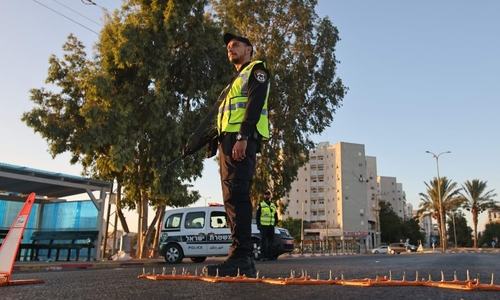
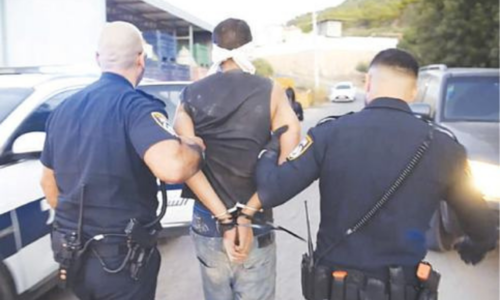
The Israeli military said the two men surrendered in Jenin, their hometown in the occupied West Bank, after they were surrounded at a hideout that had been located with the help of “accurate intelligence.” It said the men, along with two others who allegedly assisted them, were taken for questioning.
Palestinian media reported that clashes erupted in Jenin when Israeli troops entered the city. But a spokesman for Israeli police said the two escapees, Munadil Nafayat and Iham Kamamji, were arrested without resistance. The military said clashes broke out as the forces withdrew, with residents hurling rocks and explosives at troops who responded with live fire.
Fouad Kamamji, Iham’s father, told The Associated Press that his son had called him when the Israeli troops surrounded the house and said he will surrender “in order not to endanger the house owners.”
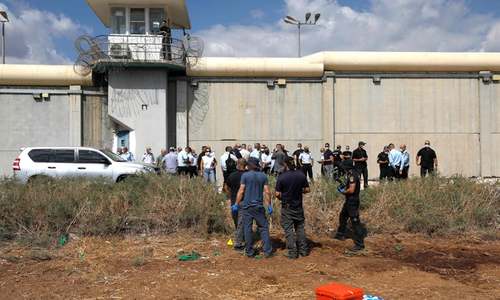
The prisoners all managed to tunnel out of a maximum-security prison in northern Israel on Sep 6. The bold escape dominated newscasts for days and sparked heavy criticism of Israel’s prison service. According to various reports, the men dug a hole in the floor of their shared cell undetected over several months and managed to slip past a sleeping prison guard after emerging through a hole outside the facility.
A massive pursuit operation followed, and the first four inmates, who also are from Jenin, were captured in two separate operations.
Prime Minister Naftali Bennett praised the various Israeli security forces that worked to recapture the men for “an impressive, sophisticated and quick operation.”
“What has broken down — it is possible to rectify,” Bennett added.
Palestinians in the West Bank and Gaza Strip have celebrated the escape and held demonstrations in support of the prisoners. The earlier arrests of four of the men prompted Gaza militants to launch rockets into Israel.
Israel considers all six of the men to be terrorists. Five are from the Islamic Jihad militant group, with four of them serving life sentences, and the sixth, Zakaria Zubeidi, is a member of the secular Fatah group of President Mahmoud Abbas. Zubeidi was a militant leader during the second Palestinian uprising in the early 2000s and well known in Israel both for his militant activity and his love for giving media interviews.
Lawyers for Zubeidi and Mohammed Aradeh, who was captured with him last week, have said their clients were badly beaten after their arrests.
Israeli security forces have been accused of torturing high-profile prisoners in the past, most recently in 2019 after a deadly bombing in the West Bank. The Shin Bet internal security service said at the time that interrogations are carried out in accordance with the law. A 1999 Supreme Court ruling forbids torture, but rights groups say it still occurs and that perpetrators are rarely held accountable.