Trade gap widens by 133pc to $4.05bn in August


 21
21


ISLAMABAD: The second month of the current financial year saw a rise of 133 per cent in trade deficit driven largely by an almost triple increase in the country’s imports compared to exports, according to the provisional data released on Wednesday.
The reverse trend was noted in trade deficit for the second consecutive month as merchandise trade deficit reached $4.05 billion in August against $1.740bn over the corresponding month last year.
The trade deficit might cause pressure on the external side, but government officials believe that increase in remittances, growth in export proceeds and Roshan Digital Account will help mitigate the pressure to a large extent.
The initial estimates show that the rising import bill might push the current account to $10bn in the FY22.
Trade deficit had reached an all-time high of $37.7bn in FY18. However, the government measures led to a drop to $31.8bn in FY19 and $23.183bn in FY20. The trend reversed and trade deficit was recorded at $30.796bn in FY21.
Exponential growth in imports blamed for reverse trend seen in second consecutive month
The trade gap has been widening since December last year, mainly led by exponential growth in imports and comparatively slow growth in exports.
The import bill in August rose by 89.9pc to $6.313bn against $3.324bn over the corresponding month of last year. On the month-on-month basis, the import bill increased by 12.7pc.
In the outgoing fiscal year (FY21), the import bill surged by 25.8pc to $56.091bn from $44.574bn the previous year.
Adviser on Commerce and Investment Abdul Razak Dawood told Dawn that he was doing an analysis of rising imports. He said maximum imports comprised raw materials and capital goods because industries were working on full capacity.
The government has carried out maximum tariff rationalisation on raw materials and capital goods during the past two years to spur industrialisation in the country. “This will be the game changer,” the adviser said, adding that this was the silent revolution in the country’s history because of cheaper imports.
Mr Dawood said that as per the State Bank of Pakistan’s statistics around 628 businesses had acquired concessionary bank loans worth Rs435.7bn for setting up new businesses and/or expanding their existing production lines in Pakistan under the Temporary Economic Refinance Facility.
He said imports were made on the import of machinery related to textiles, leather, chemicals, etc. He said imports of machinery were being made of several products. “This is a positive sign for the economy,” he said.
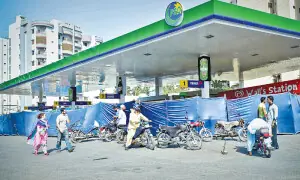
The adviser said the oil prices also increased substantially, which pushed up import bill because of high demand for energy in the domestic market. He said the government had a backup plan to sustain the pressure on external side.
The increase in import bill also helped the Federal Board of Revenue (FBR) to post substantial growth in revenue collection on import stage. It is clear from a robust growth of 67pc posted in customs collection alone in August from a year ago.
The FBR also collects sales tax and withholding tax at import stage, which gained hefty growth mainly because of rising imports.
Exports posted a growth year-on-year by 42.5pc to $2.257bn in August against $1.584bn over the corresponding month of last year. On a month-on-month basis, exports of merchandise dipped by 3.54pc.
The average monthly experts had stagnated at around Rs2.2bn for the past few years. An announcement by the commerce ministry said that growth in exports was affected by shipments’ delays due to heavy rains. The exports for August are short by $143 million of the monthly target of $2.4bn, it said.
“I urge the exporters to double their efforts to market their exports in order to achieve our target,” Mr Dawood said in a Twitter message.
Export proceeds went up by 18.2pc to $25.294bn in FY21 from $21.394bn over the last year. The commerce ministry has set an export target of $38.7bn for the current financial year. The export target of commodities for FY22 is $31.2bn and that of services it is $7.5bn.
Published in Dawn, September 2nd, 2021