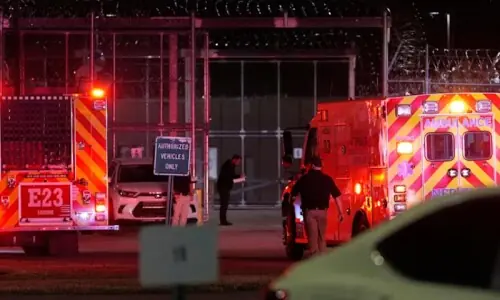
Dr Aafia Siddiqui sustained 'minor injuries' in assault by fellow inmate in US prison: FO
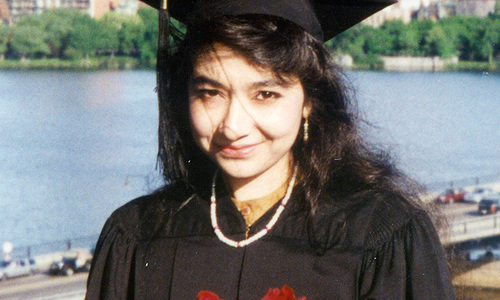

The Foreign Office (FO) on Saturday said that incarcerated neuroscientist Dr Aafia Siddiqui had received "minor injuries" after being assaulted by a fellow inmate at the Federal Medical Centre (FMC) in Carswell, US last month and was "doing fine".
Siddiqui — a US citizen of Pakistani origin — was convicted by a US court on charges of shooting at US army and FBI officers while in custody in Afghanistan and was sentenced to 86 years imprisonment.
Read: The mysterious case of the grey lady of Bagram
In a statement, FO spokesperson Zahid Hafeez Chaudhri said that authorities had learnt of the assault on Siddiqui by a fellow inmate on July 30.
"Our embassy in Washington, DC as well as our consulate general in Houston immediately took up the matter with the concerned US authorities," he said.
"Our consul general in Houston visited Dr Siddiqui immediately to ascertain her well-being. She had received some minor injuries but was doing fine," he added.
The FO spokesperson said that a formal complaint had been lodged with the relevant US authorities to investigate the matter and ensure her safety and well-being.
"Both the Pakistan embassy in Washington, DC and the consulate general in Houston continue making every effort to ensure that Dr Siddiqui is properly looked after during her incarceration at FMC Carswell," he said.
On August 19, CAGE — an independent advocacy organisation working to empower communities impacted by the 'war on terror' — said that it had received disturbing reports from Siddiqui's lawyers stating that she had been attacked in her cell by an inmate who had been harassing her for some time.
According to the statement, the inmate smashed a coffee mug filled with scalding hot liquid into her face.
"Shocked by the violent assault and in excruciating pain, Dr Siddiqui curled into a fetal position to protect herself. She was unable to get up after the assault and had to be taken out of the cell in a wheelchair," the statement said.
Case against Aafia
Siddiqui was sentenced to 86 years of imprisonment by a US federal court in 2010, after she was convicted of firing at US troops in Afghanistan while in their custody and other six charges against her.
Her lawyers had requested a sentence of 12 years, while prosecutors had pressed for a life sentence.
In 2009, a jury found had found her guilty of seven charges, including two counts of attempted murder. The jury found there wasn't premeditation in the attempted murder charges.
Prosecutors had alleged that Siddiqui, unbeknownst to some Americans who travelled to Ghazni, was behind a curtain in the second-floor room where they gathered.
She burst out from behind a curtain, grabbed an American soldier's rifle and started firing. She was shot in the abdomen by a soldier who returned fire with his sidearm, the prosecutors said.
During the trial, she testified that she was simply trying to escape the room and was shot by someone who had seen her. She said she was concerned at the time about being transferred to a “secret” prison.
Siddiqui's family and supporters claim she was arrested in Pakistan and handed over to intelligence agencies, who then transferred her into US custody. Both US and Pakistani officials, however, claim that she was arrested in Afghanistan.
Siddiqui, who received her graduation degrees from the Massachusetts Institute of Technology and Brandeis University in biology and neuroscience while living in the US between 1991 and June 2002, denied grabbing the weapon or having any familiarity with firearms.
She allegedly went missing for five years before she was discovered in Afghanistan.