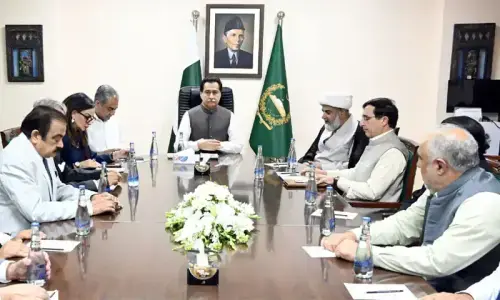
PTI Minister vows to take measures for increasing tax on cigarettes


ISLAMABAD: Minister of State for Parliamentary Affairs Ali Mohammad Khan on Thursday said the government will take all necessary measures to ensure the implementation of relevant laws to enhance tax on cigarettes.
Speaking to participants of a seminar titled ‘Implications of the Cigarette Tax Policy in Pakistan’ he said health was already a neglected sector in Pakistan.
The event was organised by Social Policy and Development Centre (SPDC) in collaboration with Society for the Protection of the Rights of the Child (Sparc). The purpose of the seminar was to share findings of recent research work on tobacco taxation conducted by SPDC and to discuss implications of tax policy for cigarette consumption, government revenues and health outcomes.
Mr Khan confirmed that the government will overcome any challenges thrown by the tobacco industry, in order to safeguard Pakistani children from the harms of tobacco.
The speakers highlighted that enhancing the federal excise duty (FED) rate would help the government achieve its commitment towards reducing tobacco use and tobacco-related morbidity, mortality, and associated economic costs. Such an increase would also advance Pakistan’s obligations as a signatory country to the World Health Organisation (WHO) Framework Convention on Tobacco Control (FCTC) and generate much-needed revenues for reducing the fiscal deficit. They said in addition to tax measures, monitoring mechanisms and enforcement of pertinent laws should also be improved, including a track and trace system as announced by the finance minister in his budget speech for 2021-22.
According to a statement, chief of sales tax and federal excise policy, Federal Board of Revenue (FBR) Girghari Mai Maghwar shared that the large fiscal imbalances in Pakistan require greater tax revenues. Tobacco taxation can positively contribute to government revenues. FBR played a key role in removal of third tier which was in the line with WHO requirements agreed by Pakistan.
Addressing participants, Malik Imran Ahmad, country head, Campaign for Tobacco-Free Kids (CTFK) said that the tobacco industry has a gross negative impact on our economy. He said that not only does the industry put a huge health cost burden of Rs615 billion on this already poor country, it also directly affects poor smokers who spend 10pc of their average monthly income on cigarettes. Due to this spending, people are left with less money available for basics such as health and education.
Raising tobacco taxes is a proven win-win policy, to not only reduce tobacco consumption as per WHO recommendations but can also generate more revenues.Unfortunately, since the last four years, there was no net increase in tobacco taxes, which rendered tobacco taxation in Pakistan among the weakest in the world,making tobacco products inexpensive and affordable for the youth. He urged the government to adopt a comprehensive National Tobacco Control Policy.
SDPC Principal Economist Mohammad Sabir said that the rates of FED on cigarettes are very low in Pakistan.
“The average excise tax share is only 45.4pc of the retail price, much lower than the widely-accepted benchmark of 70pc,” he said.
Presenting the results of SPDC’s research, he explained that no change in FED for 2021-22 would result in 270,000 more smokers and 95,000 more smoking-attributable deaths of adults in Pakistan while having marginal gains in revenues due to increased consumption. On the other hand, an increase of 30pc in FED proposed by SPDC would result in additional revenue of Rs30 billion, 220,000 fewer smokers and 77,000 lives saved.
Published in Dawn, August 6th, 2021