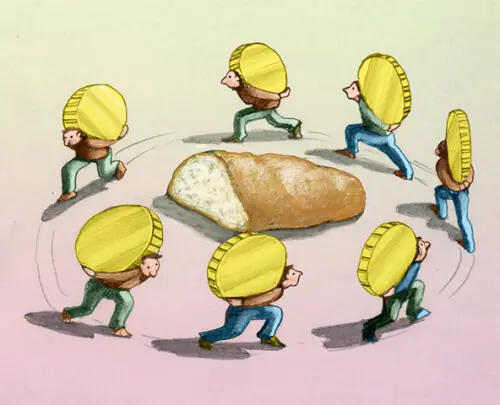
Inflation isn’t just a number. Since it affects the way people live, it has an emotional value, too. For people living below the poverty line, inflation is a curse. Inability to cope with an increased cost of living sometimes separates once-happy families — and in extreme cases triggers suicides.
This social aspect of inflation makes it a far more important economic indicator than others. Political governments do realise it and make efforts to keep inflation in check. But that often becomes a daunting task because of the complex relationship between inflation, employment and economic growth.
Creating additional jobs to reduce poverty is not possible without pushing up economic growth. And, higher economic growth cannot be achieved without letting prices of goods and services move up.
In Pakistan’s context, however, high inflation also occurs due to other factors like repeated market failures, imperfect markets, poor quality of governance, half-hearted implementation of competition laws, the existence of a large informal economy and the lack of political will to ensure enforcement of officially fixed prices of essential goods and services. As a result, general inflation remains higher than the levels required for economic growth. More worryingly, inflation measured via Sensitive Price Index (SPI) that gauges price changes in the most essential things — mostly food items and utilities — exceeds overall consumer inflation.
Unless the government puts its fiscal house in order and unless competition laws and best market practices are enforced with strong political will, managing inflation would remain problematic
In numerical terms, in the past three years of PTI government, SPI remained higher than consumer inflation. In 2018-19 it was 7.8 per cent vs 6.8pc, in 2019-20 14.4pc vs 10.7pc and in 2020-21 11.2pc vs 8.9pc. This happened for two reasons: a hike in energy prices (whose inflationary impact on food prices is far greater than on others because food demand is inelastic to prices) and repeated market failures. Wheat and wheat flour and sugar crises earned more notoriety but market failures were evident in the case of other food items, too, including meat and dairy products and vegetable oil and ghee.
This kind of inflation which reflects the imperfection of markets, weak enforcement of competition laws and even weaker implementation of “administered prices of essential items” occurs when the writ of the political government is weak. The economic policies alone cannot help contain such inflation. It will come visiting again and again unless the root causes of weak political governance are eliminated and the powerful establishment stops experiments of hybrid democracy.
Another worrying aspect of inflation is that for the last two years food inflation has remained much higher than consumer inflation. That was not the case in the first year of the PTI rule ie in 2018-19. In 2018-19, food inflation was 4.6pc and 4.8pc for urban and rural Pakistan — below general inflation of 6.8pc. But in 2019-20 and 2020-21, the food inflation stood at 13.6pc and 12.4pc in urban areas and at 15.9pc and 13.1pc in rural areas, according to the Pakistan Bureau of Statistics.
This can partly be explained by the impact of Covid-19 triggered lockdowns in the second half of 2019-20 and the first half of 2020-21 and also by the fact that global food commodity prices rose sharply amidst strong global economic recovery post the 2020 global recession.
But higher food inflation in the past two years can be attributed, at least partly, to some structural problems as well. These include low agricultural productivity, broken supply chains, hasty or delayed decision-making, poor coordination between the federal and provincial governments and among provincial governments and market manipulation by the big and the powerful.
After Pakistan’s return to the International Monetary Fund (IMF) at the beginning of 2019-20 to fix the serious balance of payments issues, the country also had to make several upward adjustments in energy prices to meet the IMF conditions. It also had to phase out energy and fertiliser subsidies available earlier to commodity-producing sectors. These factors also caused inflationary pressure in the past two fiscal years.
Since March 2020, the central bank started pursuing monetary easing to help the country brave the ill economic effects of Covid-19. This helped contain the negative economic growth to just 0.47pc in 2019-20 but at the same time kept inflationary pressures up. We saw the lagged effect of this monetary easing and the economy grew about 4pc in 2020-21.
Going forward, it is important to address structural issues in the agricultural sector and in overall governance that continue to fuel food inflation and price inflation of essential items. For making economic gains of a lax monetary policy on growth, interest rate stability is important. And, even if the State Bank of Pakistan concludes after reviewing all economic variables that a monetary tightening is a must, it will go about it gradually and in a measured way. The central bank has already made it clear. For inflation management during this fiscal year, perhaps the responsibility of the government seems greater.
Unless the government puts its fiscal house in order and unless competition laws and best market practices are enforced with strong political will, managing inflation would remain problematic. Excessive government borrowing from banks to fill in budgetary gaps is one good example of how fiscal indiscipline fuels inflation. It encourages banks to continue to ignore credit requirements of the private sector — and the private sector’s reliance on informal, more expensive, borrowings result in pricier products. On the other hand, higher domestic debt of the government results in lower investment in upgrading the infrastructure of commodity-producing sectors. That, too, eventually leads to higher inflation.
Published in Dawn, The Business and Finance Weekly, July 19th, 2021