CCI approves National Electricity Policy 2021 to reform power sector: Hammad Azhar


 13
13


Federal Minister for Energy Hammad Azhar said on Monday that the Council of Common Interests (CCI) had unanimously approved the National Electricity Policy 2021 to streamline matters related to the power sector.
“It is a historic time [for the country] as we have succeeded to formulate a national electricity policy which will have its impact in the next five to ten years when our next generations will get inexpensive and eco-friendly electricity, mainly depending on local fuels,” the minister told a news conference.
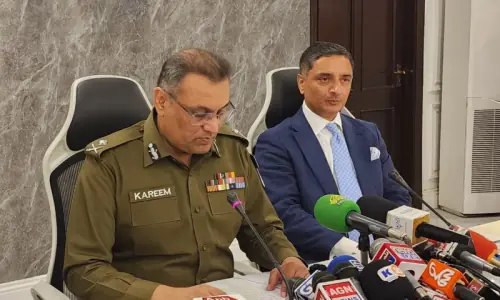
Flanked by special adviser to the Prime Minister on Finance and Revenue Dr Waqar Masood Khan, the minister said unlike in the past, the new policy was formed with a long-term view that would focus on reforming the power sector in the coming decade.
He said the policy was formulated after extensive deliberation with all the stakeholders who had discussed each and everything related to the power sector at length. “Four meetings of the CCI, in addition to more than 100 meetings with all the federal and provincial stakeholders, were held in this regard,” he added.
“Transparency, development of local fuels and more reliance on clean energy was the hallmark of the national electricity policy,” he said, adding that a national action plan would be chalked out under the initiative.
He said the policy envisioned special targets for renewable energy, long-term hydel projects and development of local fuels, paving the way to determine the power tariff through open competitive process among private investors.
The minister said the next step would be the formulation of multiple sub-policies pertaining to various sectors including generation, transmission and renewable energy, which would eventually become part of the national electricity plan whose variables would be shifted to the Indicative Generation Capacity Expansion Plan (IGCEP) model after approval of the CCI.
He said the past governments had been making abortive attempts to form such a policy, but failed to do so due to certain reasons such as lack of interest.
Hammad said the major issue in the power sector was the finances, not electricity generation as the incumbent government faced issues related to capacity payments of billions of rupees annually due to expensive agreements signed by the previous regimes with independent power producers (IPPs).
“Those capacity payments eventually did balloon the circular debt,” he added.
He said another major issue was the electricity transmission as the capacity to transmit the power had been increased up to 24,000 megawatts during the last two years.
He informed that the transmission network still required capacity addition of around 10,000 MW for which the government had allocated Rs1 billion in the budget for the new fiscal year.