G7 ministers back US proposal to tax MNCs for Covid funds


LONDON: Finance ministers from wealthy G7 nations on Friday moved towards supporting US-backed plans for a minimum global level of corporate tax aimed at getting multinationals — especially tech giants — to pay more into government coffers hit hard by the pandemic.
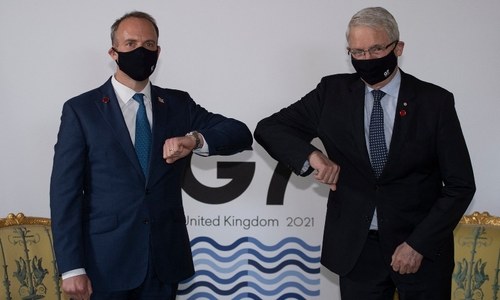
British finance minister Rishi Sunak chaired the first of two days of meetings-- held in person after an easing of Covid restrictions and attended by counterparts from Canada, France, Germany, Italy, Japan and the United States.
The talks were preparing the ground for a broader summit of G7 leaders in Cornwall, England, starting on June 11, which will include US President Joe Biden on his first foreign tour since taking office in January.
Momentum is building for a minimum level of corporate tax to prevent multinationals like tech giants from playing the system to boost profits.
Corporate tax is one of two pillars in efforts for global fiscal reforms, the other being a “digital tax” to allow countries to tax the profits of multinationals headquartered overseas.
“It is increasingly clear that in a complex, global, digital economy, we cannot continue to rely on a tax system that was largely designed as in the 1920s,” Sunak said in opening remarks.
“And I would just say this: The world has noticed. And I believe they have high expectations for what we all can agree over the coming days.
“Opportunities to make truly lasting reforms like this do not come very often, and I sincerely hope that we seize the moment.”
According to a draft communiqué, the finance chiefs and central bankers of the world’s seven richest nations will express “strong support” and a “high level of ambition” over a minimum global minimum corporate tax rate.
They then hope to reach broader agreement at a G20 finance meeting scheduled for next month.
Ministers also plan to commit to “sustain policy support”, or stimulus, for “as long as necessary” to nurture economic recovery, while addressing climate change and inequalities in society, according to the document.
Furthermore, they will urge “equitable, safe and affordable access to Covid-19 vaccines” everywhere.
The thorny topic of the regulation of digital currencies such as bitcoin will also be on the agenda.
Tax deal ‘within sight’
President Biden has called for a unified minimum corporate tax rate of 15 percent in negotiations with the Organisation for Economic Co-operation and Development (OECD) and G20.
His proposal has so far won broad support from countries such as France and Germany, as well as the International Monetary Fund.
A deal on a minimum corporate tax rate is “within sight”, finance ministers from France, Germany, Italy and non-G7 member Spain declared Friday.
“We have a chance to get multinational businesses to pay their fair share,” France’s Bruno Le Maire, Germany’s Olaf Scholz, Italy’s Daniele Franco and Spain’s Nadia Calvino said in The Guardian newspaper.
“For more than four years, France, Germany, Italy and Spain have been working together to create an international tax system fit for the 21st century,” added the four ministers.
“It is a saga of many twists and turns. Now it’s time to come to an agreement.”
Current G7 host Britain has previously called for a broader package of tax reforms.
Ireland has expressed “significant reservations” about Biden’s plan. Its 12.5-percent tax rate is one of the lowest in the world, prompting tech giants such as Facebook and Google to make Ireland the home of their European operations.
Official data showed Ireland’s economy grew almost eight percent in the first quarter, as multinational firms’ revenues helped it continue to buck neighbours’ pandemic downturns.
The UK-based anti-poverty charity Oxfam on the other hand argued that Biden’s proposal of 15 percent was too little.
“A rate of 15 percent would in our opinion be largely insufficient,” Oxfam France’s senior policy officer Quentin Parrinello said.
Proponents argue that a minimum tax is necessary to stem competition between countries over who can offer multinationals the lowest rate.
They say that a so-called “race to the bottom” saps precious revenues that could go to government priorities like hospitals and schools.
Published in Dawn, June 5th, 2021