0
0
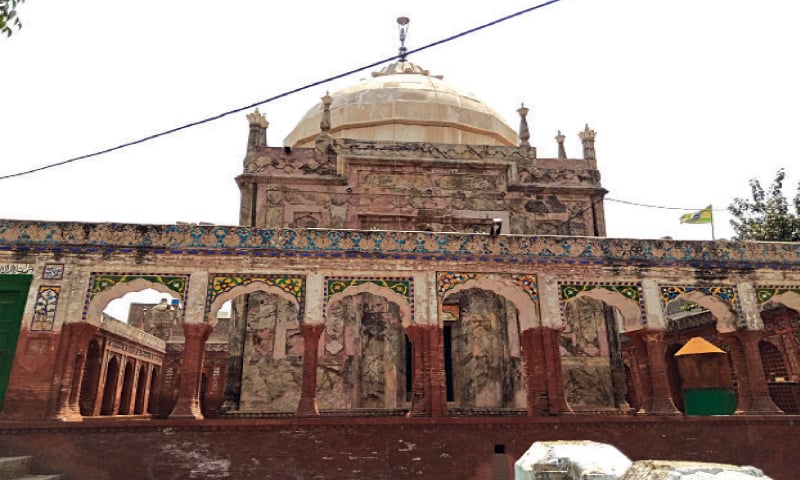

CHINIOT: The shrine of Hazrat Shah Burhan, a 17th-century Mughal-era monument located here has been left to decay by the authorities concerned, allowing its grand architecture and ornamentations to be swept away by the ravages of time.
As per local historians, Shah Burhanuddin Bukhari, born in 1605 A.D, was a disciple of Hazrat Mian Mir. His forefathers had migrated to India from central Asia and settled in Lahore from where he moved to Chiniot in 1630 and converted a large number of local Hindu and Sikh clans to Islam with his preaching. He died in 1669 and his Urs is celebrated on 12th of Ramazan.
Later on, Nawab Saad Ullah Khan, prime minister of Mughal Emperor Shah Jehan, built a grand complex spreading over several acres, comprising Shah Burhan’s tomb, a well, a pond and a mosque to honour the saint.
The walls of the tomb and its grand dome are adorned with intricate and colourful fresco work, a hallmark of Mughal architecture. Persian language quotes written inside the tomb add to its grandeur. The well and the pond were meant for supplying water to the visitors to the monument.
However, with the passage of time the rot set in and people started encroaching upon the shrine land, reducing it to a great extent. After the Partition, this shrine was handed over to the Auqaf department, but instead of making efforts to preserve the monument, its local officials’ main concern appears to be collecting the donations given by the devotees and the fees from the vendors who set up stalls on the premises during the annual Urs.
Because of the persisting official neglect the structure of the monument has been decaying fast. The fresco panels on the walls are fading and bricks have either been stolen or decayed at many places of the complex. At some places cracks have appeared in the walls, threatening the structure. The well had been closed for a long time, while the pond that once catered to the visitors’ need of clean water for ablution and drinking has gone dry.

The main gate of the shrine had broken and was never repaired since. The empty part of the complex’s land has been reclaimed by nature, filling it with thorny bushes and weeds.
A couple of years ago, the then deputy commissioner, Aman Anwer Kedwai, had chalked out a plan to revive the historical monuments of Chiniot, in collaboration with the Archaeology and Auqaf departments. Under the plan some rehabilitation work was done in the local Badshahi mosque, another Mughal-era relic, but the project was halted after the officer was transferred in November 2019.
Dr Irshad Thaheem, a local historian, regretted the government’s apathy towards the monument and demanded Punjab Chief Minister Usman Buzdar to order its preservation and restoration to save it from total collapse.
Sitting DC Syed Masood Noman, who has been posted here less than a month ago, has pledged measures to preserve historical buildings and sites in the district.
Published in Dawn, May 17th, 2021