Tokyo Olympics chief commits to Games as infections surge

TOKYO: Tokyo’s Olympics chief said on Friday that Japan was committed to holding a safe Games this summer, as a surge in Covid-19 cases prompted an expansion of contagion controls and with fresh calls for the Games to again be postponed or cancelled.
The government expanded quasi-emergency measures to 10 regions as a fourth wave of infections spread, casting more doubt on whether the Olympics can be held in Tokyo in fewer than 100 days.
Organising committee president Seiko Hashimoto was asked at a news conference if there were any conditions under which the Olympics would be canceled.
The question comes as the general secretary of ruling LDP political party, Toshihiro Nikai, raised the possibility the day before.
“We’re not thinking of cancelling the Olympics,” Hashimoto said, speaking on behalf of the organising committee. “We will continue to do what we can to implement a thorough safety regimen that will make people feel complete safety.”
Hashimoto acknowledged Nikai’s concern and suggested it was probably shared by the Japanese public. Polls show as many as 80 per cent in Japan oppose holding the Olympics during the pandemic.
“The fact that he [Nikai] is concerned is a point that we need to take seriously as Tokyo 2020,” she said. “His comment has reminded us of how tedious it was for us to feel confident or be fully prepared for delivering the games.”
The government added Aichi, Kanagawa, Saitama, and Chiba to six other prefectures already under contagion controls, including the cities of Tokyo and Osaka.
Japan’s top health experts have acknowledged that the Covid-19 pandemic has entered a fourth wave.
Daily cases in Osaka reached a record 1,209 on Friday, driven by a virulent strain of the virus first identified in Britain. New infections in Tokyo were 729 on Thursday, the most since early February when most of the nation was under a state of emergency.
Almost two-thirds of Japanese said the Olympics should be cancelled or postponed, a Jiji news poll showed on Friday.
A senior ruling party official said on Thursday that cancelling this year’s Olympics remains an option if the coronavirus situation becomes too dire.
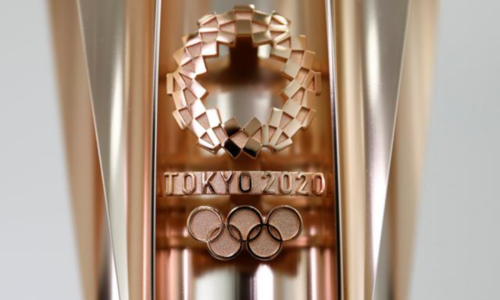
A scaled-back torch relay is already underway. Olympic organisers said on Friday that on the main island of Okinawa in Japan’s southernmost Okinawa prefecture they would stage the relay in restricted areas without spectators instead of on public roads.
Overseas fans have been barred from the Games and officials say that domestic fans may be kept out too.
On Thursday, the government minister in charge of Japan’s vaccine rollout, Taro Kono, said even if the Olympics go on, there may be no fans of any kind in the venues. He said it’s likely that the Olympics will have to be held in empty venues, particularly as cases surge across the country.
Hashimoto, who had said previously that a decision on venues would come in April, seemed to push back that deadline. She was not asked about Kono’s suggestion and did not raise the issue or challenge it.
“Within April I would like to set the basis direction,” she said. “The final judgment time this as well we need to monitor the situation of the pandemic and we need to remain flexible for that.”
Underscoring the difficulties of planning during the pandemic, Tokyo Olympic organisers postponed another test event, the BMX freestyle cycling scheduled for April 24-25, because of the impact on scheduling from the Covid-19 situation.
Olympic and government officials have said further postponement of the Games is out of the question.
But a groundswell of health experts have said it’s too risky to hold the Games this summer. Compounding the problem is Japan’s relatively slow inoculation push, which began February using imported vaccines.
Japan has exhibited “poor performance” in containing virus transmission, along with limited testing capacity and a slow vaccination rollout, according to a commentary of health experts published in the British Medical Journal on Wednesday.
“Plans to hold the Olympic and Paralympic games this summer must be reconsidered as a matter of urgency,” wrote lead author Kazuki Shimizu of the London School of Economics.
“Holding Tokyo 2020 for domestic political and economic purposes--ignoring scientific and moral imperatives--is contradictory to Japan’s commitment to global health and human security.”
Hashimoto said Japanese athletes were not a priority for vaccination. Putting athletes at the head of the line has been largely opposed in Japan.
The IOC has said vaccination is not a requirement to participate in the Olympics. On the other hand, IOC President Thomas Bach has left no doubt he wants as many athletes vaccinated as possible.
Japanese Olympic Minister Tamayo Marukawa told reporters on Friday that the government is considering conducting daily virus tests on athletes during the games as a way to guarantee safety. Previous plans had called for virus tests every four days.
Marukawa also said the government was not talking about prioritising athletes for vaccination.
Published in Dawn, April 17th, 2021