0
0

ISLAMABAD, Oct 17: Prime Minister Shaukat Aziz on Monday launched a 12-point plan for the relief and rehabilitation of earthquake-stricken areas of AJK and NWFP and said the government was committed to turning this adversity into an opportunity for development.
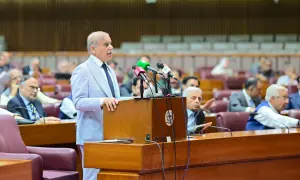
Prime Minister Aziz was speaking at the Jammu and Kashmir Council which was attended, among others, by AJK President Sardar Mohammad Anwar Khan and AJK Prime Minister Sardar Sikandar Hayat Khan.
Mr Aziz, who is also the chairman of the council, asked those involved in relief and rescue operations to focus on moving survivors from mounds of rubbles to tents and decent transitional shelters as quickly as possible.
This will ultimately help in moving towards construction of model cities for permanent settlement of homeless people while accounting for concerns regarding the “titling” issue.
Unfolding the plan, Prime Minister Aziz asked for identifying overlaps and gaps in relief to impacted areas, regulating private, foreign and public sector relief goods and services and filling gaps that exist in the distribution of goods.
The plan includes gearing up of medical and trauma treatment of the injured and chalking out a detailed plan for permanent settlement of orphaned boys and girls, including their education.
Arrangements for transitional schools, hospitals and other public offices to restore the government structure are also part of the plan.
Reconstruction plan for the quake-flattened areas, covering full restoration of infrastructure, setting of priorities, and implementation of the plan in an accountable and transparent manner with participation of people and elected representatives is also to be put in place.
He called for preparing “Transitioning from Tents to Communities Plan” entailing damage assessment, permanent shelter and housing programmes, credit and other livelihood programmes, and funding for cash-for-work programmes to speed move from tents to more permanent communities.
Prime Minister Aziz called for a plan to restore the livelihoods of survivors, to finance new economic activities to raise family incomes above their pre-earthquake levels, and to increase the capacity of local governments, NGOs and businesses to undertake the reconstruction effort.
Jobs for local people in the reconstruction will require large vocational training programmes as thousands of masons, woodworkers, supervisors and labourers will be needed. About 200 NGOs are coming which would also need manpower in those areas, he said.
He called for making an estimate of financial requirements and identifying gaps by devising a reporting system to ensure that donations were being used appropriately, and a unified scorecard to show what we had achieved and what remained to be done.