0
0

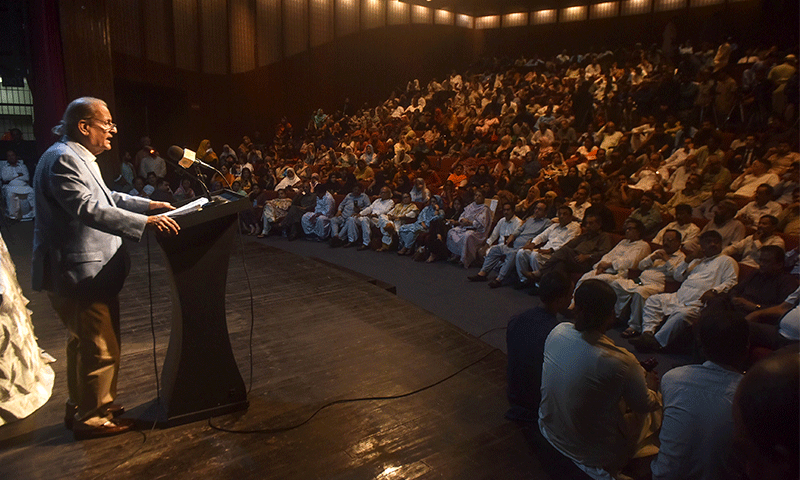
HYDERABAD: Speakers at a session on Shah Abdul Latif Bhitai in the 6th Hyderabad Literature Festival that ended on Sunday evening stressed the need for reintroducing Bhitai to present and future generations so that they can understand and own the great Sufi poet.
The last day of the festival held different sessions on short stories, folk literature, history and civilisation. At the session on ‘recent research, digitalisation and preservation of Shah Abdul Latif Bhitai’s works, Amar Fayaz said that Sindh had produced Moenjodaro, Shah jo Risalo and Sindhi language for entire world.
He said that when science was being talked about in Europe in the 17th century, Bhitai was discussing philosophy. Regretfully, people could not understand Bhitai, hence there was dire need to reintroduce Bhitai today so that present and future generations could understand and own him, he said.
He said that culture department had developed pages on Bhitai on Wikipedia to ensure the poet’s outreach to 750 billion population of the world. A roadmap was being prepared to show areas where Bhitai had travelled, he said.
Co-panelist and researcher Saleem Bhutto Latifi said that after digitalisation of Bhitai’s work, he would be easily understood. The digitalisation had protected Sindhi language, culture and civilisation, which were faced with multiple threats, he said.
At another session, English book on Thari folk songs Khusboo Thari lok geetan ji by noted writer Noor Ahmed Jinjhi was launched.
Dr Sher Mehrani said that the book was based on history and research and it shed light on Thari culture and life to help the reader understand beauty of Thar. Jinjhi had secured recognition for folk songs of Thar on international level, he said.
Ghulam Ali Buriro, writer, said that history of folk literature was long. Folk songs in fact represented hope and folk literature encouraged people to raise voice against injustice, he said, adding Sindhi folk literature was unique in the world.
Dr Fareeda Panhwar said that she read through this book within two days. Massive work had been done on folk literature in Sindhi but it required serious efforts to project folk literature in English language, she said.
The author Noor Ahmed Jinjhi said that folk literature was a great asset and it showed that man was progressive even centuries ago. Folk songs represented language of heart, he said.
At a session on Sindhi short stories moderated by Akhtar Hafeez one of the speakers Ikhlaque Ansari said that Sindhi short story was quite powerful. International standard in fact belonged to land and not to short story, he said.
Short story writer Kaleem Butt said that subject made a short story popular. A short story could not be confined to 100 words because it was free of all kinds of bars, he said.
Jaffar Shahani, writer, said that he felt that extremism was an important subject for writing on and that was why he wrote stories in the backdrop of 9/11 tragedy and bombing at Lal Shahbaz shrine. Extremism could be defeated with the help of short stories, he said.
Sindhology director Mehmood Mughal, Ishtiaque Ansari, Gul Badan Javed Mirza of Adabi Board and director Dr N.A. Baloch institute Altaf Jokhio said at a session on Sindh’s education and literary institutions that educational and literary institutions of Sindh were performing their duties and there was need to strengthen them instead of criticising them all the time. However, they said that criticism for the sake of reforms must be welcome.
A book on profile writing by senior journalist Niaz Panhwar was launched at a session moderated by Zahida Detho. Panhwar said that profiles on different personalities written by him could not be contradicted as all the profiles were very close to reality.
Published in Dawn, March 22nd, 2021