Syrian ‘father of martyrs’ raises orphaned grandchildren


HARBANOUSH: Syria’s war robbed 83-year-old Abderrazaq Khatoun of 13 of his children and one of his wives, but he was forced to overcome his grief quickly to raise 11 orphaned grandchildren.
In an encampment in Syria’s last major rebel bastion of Idlib, the patriarch says he wears the nickname of “father of the martyrs” with pride, and will do everything to prepare the children for a better future.
Displaced from his native home in central Hama province, Khatoun and 30 surviving family members have pitched four tents on a strip of land surrounded by olive trees in the village of Harbanoush.
Inside one of the tents, Khatoun sat on a long thin mattress, his grandchildren aged from one to 14 huddled around him poring over schoolbooks.
“What did you study today?” he asked the oldest among the boys and girls.
“Did you learn the lesson?” “We did,” they replied in enthusiastic unison.
Before the war, Khatoun was a farmer and the proud father of 27 children, born from three different wives and some already well into adulthood.
But Syria’s conflict, which enters its eleventh year this month, has torn away a huge chunk of his family for good.
“Since the onset of the revolution, I have given seven martyrs,” he said, referring to seven of his sons who died fighting in rebel ranks against government forces.
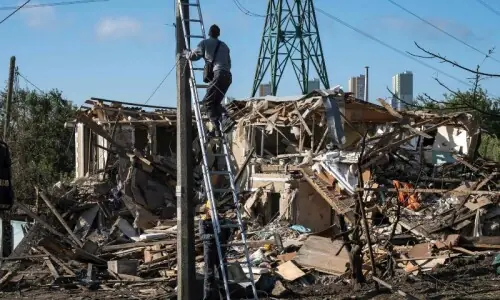
Then air strikes on a petrol station in the town of Saraqeb, where his family had found shelter from advancing regime troops, piled more tragedy on his family.
“I lost seven more members of my family — my wife and children,” he said, adding that some of his offspring were small children.
His eyes brimmed with tears as he pulled out his smartphone and played footage of rescue workers searching the rubble in the aftermath of that strike.
“In an instant, I lost them all,” said Khatoun, struggling to remember the exact date of the tragedy.
The Syrian Observatory for Human Rights, a Britain-based war monitor, says a deadly air raid by regime ally Russia hit a petrol station in the town in January 2020.
Syria’s war has killed more than 387,000 people and displaced more than half the country’s pre-war population since it started in 2011 with anti-government protests.
But Khatoun says he has no regrets.
“Losing children is devastating, but defending your land requires sacrifice and I’m proud of them,” he said of his sons who died on the battlefield.
“They were in the flower of their youth.” He hopes one day, justice will be done for his sons.
In the meanwhile, “I will teach their children that sacrifice is necessary to defend what is right and demand a dignified life,” he said.
Today the Damascus government controls more than 60 percent of Syria after a string of Russia-backed victories against jihadists and rebels since 2015.
But a ceasefire has since March 2020 largely held in the jihadist-dominated region of Idlib, where two thirds of 2.9 million inhabitants have been displaced from other parts of the country.
Inside one of the family tents, Khatoun’s 11 grandchildren crouched in a circle for a meal of flatbread, olives, and dried thyme drenched in olive oil.
The 14-year-old, clutching a toddler on her knee, passed around the bread.
Behind them, some towels hung on a line strung across the canvas wall.
“Some days we go hungry, and some days we eat,” said Khatoun, explaining that he was too old to work. But he said he would do anything for his grandchildren.
I hope “they live happy lives and that they remember the tales of their fathers sacrificing themselves to defend the land,” he said.
I want them to “have a house, not a tent, and a car to travel around in,” he said.
“I won’t deprive them of anything as long as I live.” Batoul, one of his widowed daughters-in-law helps him look after the children, after some of his surviving children left war-torn Syria seeking a better life in neighbouring Turkey and Lebanon. “We have suffered a lot,” she said, mourning her late husband.
But “my father-in-law tries hard to provide us with a dignified life.”
Published in Dawn, March 15th, 2021