UAE's 'Hope' probe sends home first image of Mars

Published February 14, 2021
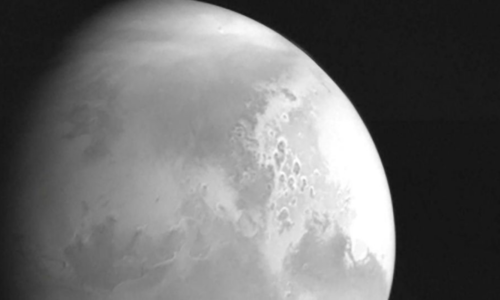
A handout picture provided on Feb 14, 2021 by the United Arab Emirates Space Agency taken by the Emirates eXploration Imager after Mars Orbit Insertion on board the First Emirates Mars Mission from an altitude of 24,700 km above the Martian surface shows the Olympus Mons, the highest volcano on Mars, and the Tharsis Montes, three volcanoes named Ascraeus Mons, Pavonis Mons and Arsia Mons. — Photo via AFP

The UAE's “Hope” probe sent back its first image of Mars, the national space agency said on Sunday, days after the spacecraft successfully entered the Red Planet's orbit.

The picture “captured the largest volcano in the solar system, Olympus Mons, emerging into the early morning sunlight,” it said in a statement.

The image was taken from an altitude of 24,700 kilometres above the Martian surface on Wednesday, a day after the probe entered Mars' orbit, it said in a statement.

Sheikh Mohammed bin Rashid Al-Maktoum, UAE prime minister and Dubai's ruler, shared the coloured image on Twitter.

“The first picture of Mars captured by the first-ever Arab probe in history,” he wrote.

The mission is designed to reveal the secrets of Martian weather, but the UAE also wants it to serve as an inspiration for the region's youth.

Hope became the first of three spacecraft to arrive at the Red Planet this month after China and the US also launched missions in July, taking advantage of a period when the Earth and Mars are nearest.

The UAE's venture is also timed to mark the 50th anniversary of the unification of the nation's seven emirates.

“Hope” will orbit the Red Planet for at least one Martian year, or 687 days, using three scientific instruments to monitor the Martian atmosphere.

It is expected to begin transmitting more information back to Earth in September 2021, with the data available for scientists around the world to study.

Opinion

Editorial

A difficult story
Updated 12 Jun, 2026

A difficult story

Unless productivity becomes the dominant target of economic policy, Pakistan will continue to oscillate between crises and fragile recovery.
Rough waters
12 Jun, 2026

Rough waters

AMONGST the key potential triggers for fresh conflict in South Asia is water. The Indian state is behaving in an...
Politicised football
12 Jun, 2026

Politicised football

ALMOST three-and-half years since Lionel Messi led Argentina to FIFA World Cup glory, the latest edition of...
GB polls’ aftermath
Updated 11 Jun, 2026

GB polls’ aftermath

The new administration must address the region’s issues proactively.
Peace in retreat
11 Jun, 2026

Peace in retreat

THE ceasefire announced in April was supposed to create space for negotiations. Instead, it has been repeatedly...
A few good men
11 Jun, 2026

A few good men

IT was a brave move, no doubt. This Tuesday, in the land of the Afghan Taliban, a few good men decided to take a...