0
0

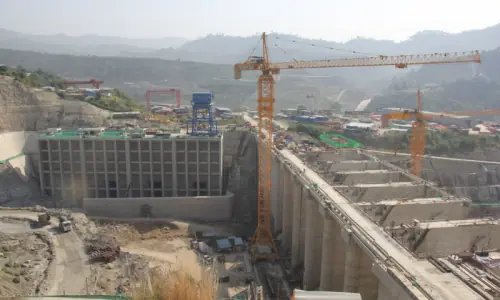
NEW DELHI, Oct 7: The Baglihar dam dispute between India and Pakistan is likely to end peacefully in January when the World Bank-appointed neutral expert is expected to deliver a formal verdict on the issue, official sources said on Friday.
The issue moved into the realm of legal experts and technical advisers representing the involved three sides, India, Pakistan and the World Bank, who will now meet in Geneva on Oct 20 and 21 to start a process of tricky discussions that could last till January, the official sources told Dawn.
They said the representatives of India and Pakistan and World Bank nominee Raymond Lafitte held in depth discussions here on Friday to set stage for a possibly acrimonious legal argument on their dispute over the flow of river Chenab from Kashmir.
Mr Lafitte might hear the legal and technical arguments until late January, but is believed to have accepted February, as the last deadline to announce his verdict, which he says would be binding on both countries.
According to reliable reports, Pakistan led the field with an international consultant hired by the National Engineering Services Pakistan (Nespak). Peter Joseph Rae is a hydrologist from Canada and is reported to have prepared the case for Pakistan.
The Indian Express estimated that Pakistan has spent $12 million to build its case against the Baglihar dam.
To match this, India has fielded a German consultant from the Lahmeyer International. They have been hired by the Jammu and Kashmir State Power Development Corporation to do a design review and assist in contact negotiation.
Representing the German consultant is Wolfgang Schwartz, a leading geologist who specialises in hydro-projects.
On the legal front, senior lawyer Fali Nariman will argue India’s case while Faizal Hussain Naqvi, who accompanied the team to the project site, will be Pakistan’s counsel.
Pakistan has to prove that the dam project actually stores water in a reservoir behind the gated spillways, depriving Pakistan its share of the Chenab waters. Briefly put, it will have to establish that the design violates the spirit of the Indus Water Treaty.
During the visit in India, Mr Lafitte visited the engineering town of Roorkie where he was shown a detailed model of the dam on Thursday.
Friday’s discussions between the three sides were reported to be “involved and technical”.
Having taken detailed minutes of the raging controversy, Mr Lafitte was to leave for Geneva late on Friday.
India says the Baglihar site is actually a run-of-the-river project and does not store water in a reservoir.
Hence, the design experts have a key role to play. To go into the fine print of the Indus Water Treaty, signed between India and Pakistan in 1960, would be the job of the legal experts.
One operational clause in the treaty says that the flow of the river should not be disturbed, experts said.