Nawaz, Vajpayee spoke over phone in midst of Kargil war, says book


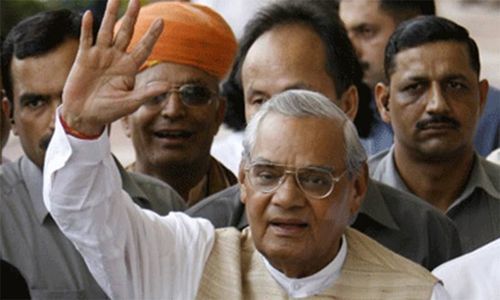
NEW DELHI: Former prime minister Nawaz Sharif and his Indian counterpart, Atal Bihari Vajpayee, spoke to each other on the phone at least five times during the course of the 1999 Kargil war, with the latter veering to the view that Mr Sharif had been bamboozled by then army chief General Pervez Musharraf into the conflict, The Hindu said on Sunday, quoting from a new book by Mr Vajpayee’s private secretary.
The book on Mr Vajpayee’s tumultuous tenure, Vajpayee: The Years That Changed India by former bureaucrat Shakti Sinha, who served as Vajpayee’s private secretary for many years, goes on to say that the communication was kept up after a telling incident between Mr Sharif and R.K. Mishra, a former head of the Observer Research Foundation (ORF), the man selected for back channel talks to end the conflict.
“…Sharif’s position was a tenuous one, and in a later meeting, he indicated to Mishra that they should take a walk in the garden, obviously suspecting that his own house was tapped. When Mishra reported this to Vajpayee, the latter took this as an indication that Sharif was more a prisoner of circumstances than anything else,” says the book.
One of the calls occurred in June from Srinagar, after Vajpayee had made a visit to Kargil. “On his arrival in Srinagar, Vajpayee asked me to connect him to Sharif. My small team and I tried, but we just could not get through. Then one of the local officers present informed us that dialling Pakistan (+92) from Jammu and Kashmir was barred. The telecom authorities were told to open the facility for a short while, so that the two prime ministers could talk,” says the book.
A major factor in the withdrawal of Pakistani troops from the LoC, the book claims, was two telephonic recordings that Arvind Dave, then chief of Research and Analysis Wing (R&AW), India’s external intelligence agency, brought to Prime Minister Vajpayee. “Arvind Dave, the R&AW chief, came up with two telephonic recordings between the Pakistan Army chief Pervez Musharraf, and his chief of general staff, Lt Gen Mohammad Aziz. It was clear that the Pakistan Army was involved, with the Mujahideen playing a minor role, if any,” says the book.
The tapes were shared with the media later, but were also smuggled into Pakistan for Mr Sharif via the diplomatic route along with diplomat Vivek Katju and back channel point person R.K. Mishra.
Published in Dawn, December 21st, 2020