Footprints: HUFF AND PUFF AND HUTS MADE OF BRICKS



“HEY, are you looking to rent a hut?” Lal Mohammad, a guard hovering around some huts in Hawkesbay, asks as he skips, hops and skips towards your car window. Asked how much can one rent a beach hut for, he says: “Rs25,000 for a day.”
Then noticing a lack of interest, Lal Mohammad tells you that the amount is low compared to how much the nice huts are rented out for during the summer months. “It’s winter season now and we don’t find many picnickers coming here, so asking for so little money. In summers, we will rent you the same huts for Rs50,000 or more,” he says.
Still unable to strike a deal, he points to a rickety structure full of cracks. “This I can give you for four to five thousand. It is nice and clean from the inside, not as bad as it looks from the outside. What say you?”
Words from the recent protest of hut allottees outside the Karachi Press Club echo in the head: “They are beachfront huts, so they need much repair the year round due to the corrosive salt spray from the sea. Then due to the coronavirus pandemic there are not many people coming to the beach this year. Besides, for two to three months during the monsoons there is a Section 144 imposed, banning people from going into the water and in winter there is a dearth of picnickers anyway. We are barely earning two to two-and-a-half lakhs annually from the huts....”
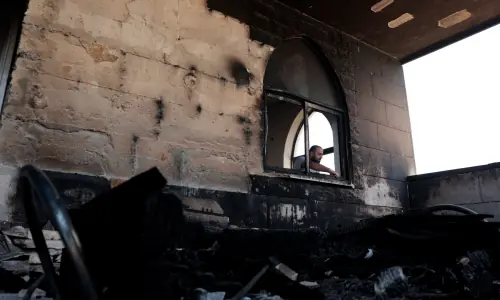
A small and simple seaside shelter providing shade from the sun was what used to be known to most people as a ‘hut’. But just like the wishful line picked up from the back of a rickshaw, “I will grow up one day to be a truck”, the huts on lands measuring 80 to 100 square yards in the Hawkesbay and Sandspit area have grown into palatial bungalows.
And the allottees of these lavish places are feeling nervous as hell after the Karachi Metropolitan Corporation (KMC) sent them notices to vacate them so that the land on which they have been built could be auctioned off. The land allotted to people to build these huts is all KMC property and it can do whatever it jolly well pleases to do with it. Besides, the allotments are done for a said period of time, three years in this case.
For some allottees, KMC had even stopped accepting the annual fee of Rs16,000 to Rs22,000 (the amount depending on size of the plot) and those this happened to are saying that they were deliberately turned into defaulters. But could it be possible that the fee was not being accepted because the KMC had canceled the allotment?
Another line from that protest comes to mind: “We are taxpayers. We are respectable citizens. You cannot treat us like this! The huts don’t belong to KMC, only the land does. We spent money building the huts. What of that?”
But what has one being a taxpayer got to do with it?
“Look nothing is going to come of it,” another hut guard, and quite a confident one at that, tells you. “There are huts here that belong to banks, companies, government departments, etc. Besides, ‘the owners’ have approached the court of law for now for a stay order regarding the matter,” he adds.
Owners?
Once again your mind takes you back to the protest. The protesters that day had arrived much after the time given to the media by them. While waiting with pen and paper in hand and photographers and cameramen on standby, the journalists inquired from the two or three persons, who had arrived in their 4x4s and were preparing to fix some posters atop their vehicles, when the rest of them were going to reach there. In response they asked the journalists to be patient.
When one female reporter retorted by saying “how about being punctual? The media has other things to cover, too,” she was told: “The media doesn’t deserve any such consideration because they will report if anything is worth reporting anyway.” Yet another journalist, who requested to see a copy of the allotment letter, was told to shut up.
Returning to the present, you look at the confident guard and nod before turning to leave. You look at the old long and narrow driveways leading to the huts. Only a few have the old chain or bamboo barriers now as most have tall gates in their place.
You also see the broken Styrofoam plates, empty and crushed juice boxes and plastic bags stuck in between wild shrubbery growing in the sand. Most of all, you just can’t miss the broken bottles of imported liquor lying around amid the mess.
Published in Dawn, December 14th, 2020