0
0

 THE consumption of energy is one of the critical indicators of the level of development of any country. Pakistan’s total primary energy supplies measured in terms of tons of oil equivalent (toe) stood at 50.8 million toe in 2003-04. The primary energy supplies have been rising steadily over the last several years. It was 45.2 million toe in 2001-02, increased by 4.4 per cent in 2002-03 and further grew by eight per cent in 2003-04 to stand at 50.8 million toe.
The per capita energy consumption in Pakistan is currently low at 14 mbtu as compared to 92 mbtu for Malaysia and 34 mbtu for China.
According to Economic Survey 2004-05, the real GDP growth has jumped from 5.1 per cent in 2002-03 to 6.4 per cent in 2003-04 and further to 8.35 per cent in 2004-05. The government has targeted 7-8 per cent growth in next five years, which demand a proportionate rise in the energy use.
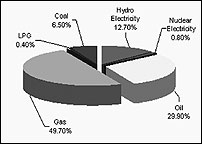
Oil, natural gas, electricity, coal and LPG contributed 29.9 per cent, 49.7 per cent, 13.5 per cent, 6.5 per cent and 0.4 per cent respectively to primary energy supplies in 2003-04.
During the last few years, consumption of oil in cement industry as well as in electricity generation has declined substantially as the former has shifted to gas as well as on coal at the same time. Gas is increasingly being used to generate electricity.
Although average consumption of petroleum products has registered an average decline of 6.5 per cent per annum since 2000-01, consumption of gas, electricity and coal has grown at an average rate of 10.4 per cent, 6 per cent and 14.6 per cent, respectively.
Due to import of high cost energy resources, the government has planned to enhance the share of coal in the over all energy mix from five per cent to 18 per cent up to 2018.
Irrespective of all government schemes, the total national coal production from coal mines during 2004-05 remained at around five million, and 80 per cent of it was consumed by the brick kiln industry.
Almost 80 per cent of cement industry has now switched over to indigenous coal from furnace oil that has saved considerable foreign exchange which was being spent on the import of furnace oil. It is expected that conversion of all cement industry to coal would generate demand for 2.5 million tons of coal per annum by 2010.
A breakdown of the estimated value of energy resources, oil has estimated value of $6 billion, gas has $25 billion, whereas, coal has estimated value of $5,540 billion.
The overall use of energy in Pakistan is around 70 million tons of coal equivalent (mtce) per annum, and it is estimated that it will grow to over 90 mtce by 2008.
Indigenous production accounts for some 65 per cent of the energy used. With the likely growth in energy use, and limitations in the internal supply of oil and gas and little investment in coal sector, this proportion is likely to drop.
During the 1990s, a substantial coalfield was discovered in the Thar Desert, sufficient to meet long- term fuel requirements of the country for centuries. The Thar coalfield covers an area of approximately 3,500 square miles and is estimated to contain 193 billion tons of lignite resources. The coal is lignite, with a moisture content ranging from 42–49 per cent and it lies at depths between 130 and 250 metres.
Four tracks of the Thar coalfield currently undergoing more detailed assessment, where the overburden is thinnest and the seam thickness greatest, comprising an area of about 138 square miles, are estimated to contain three billion tons of recoverable coal reserves. This represents 89 per cent of Pakistan’s total recoverable reserves.
Analyses of Thar lignite indicate relatively high heat content, between 9.4 and 12.7 million btu per ton. Coking coals produced in the United States have an estimated heat content of 27.4 million btu per ton. The most appropriate large-scale application of the lignite is for power generation and worldwide more than 90 per cent of the lignite and brown coals are used for power generation.
Although the government has planned to increase its power generation capacity by 143,000 mw in the next 25 years to 162,540 mw from the current 19,540mw to sustain GDP growth rate of 7-8 per cent, which includes 19,750mw coal-based production, currently the contribution from coal power sector is negligible.
Based on common practice elsewhere, the most likely technologies to be appropriate for Thar lignite are either pulverized coal combustion with flue gas recirculation, or circulating fluidized bed combustion, probably with limestone addition to the bed.
Sindh government has signed a memorandum of understanding for (i) a 600mw Thar coal power project by Shenhua Group of China, and (ii) a 1200mw project at Thar with an Australian firm using “underground coal gasification technique. Shenhua Group Corporation project has requested for development of infrastructure at Thar coalfield for smooth implementation of the project.
The Chinese have also requested for the up-gradation of the roads from Karachi to Islamkot as per required specification before start of the project to enable for transportation of equipments and machinery up to the project site.
The Thar coal field is connected with the three routes, Karachi-Hyderabad-Mirpurkhas -Umerkot-Islamkot, Karachi-Hyderabad-Mirpurkhas -Maukot-Mithi-Islamkot and Karachi-Thatta-Badin-Tando Bagho-Judho-Naukot-Mithi-Islamabad. But the government’s response is slow.
Thar is an area mired in poverty. Rain is the main source of water in Tharparkar arid region. All agriculture and livestock activities are dependent on rainfall, which is very erratic, with the annual rainfall varies from 0-300 mm. The poverty is enhanced by perennial droughts. The failure of monsoon means no agricultural crop and no fodder for the cattle and livestock.
The Thar desert requires seasonal showers for vegetation, crops, animals, palar (drinking water) and toba (community water pool), but drought has continuously increased the misery of its inhabitants over the last 6/7 years.
The people of Sindh are taking government’s lack of interest in the developing of Thar coal field and optioning for highly controversial hydro project as an injustice against peoples of the small provinces. The proposed hydel project is anticipated to hurt agriculture of Sindh, especially downstream of Kotri.