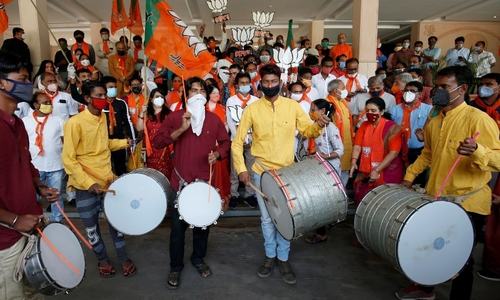
Modi's party, allies win vote in India's key Bihar state

India’s ruling party and its allies have won a key state election seen as a barometer of Prime Minister Narendra Modi government’s handling of the coronavirus pandemic and the resulting economic downturn.
Modi’s Bharatiya Janata Party (BJP) and his regional ally Janata Dal United won 125 seats of Bihar state’s 243-seat legislature, India’s election commission website showed on Wednesday. A coalition of more than three political parties opposed to the incumbent alliance was trailing with 110 seats.
The counting process took much longer than usual as more electronic voting machines were deployed to avoid crowding in polling centres in an effort to halt the spread of coronavirus.
“Democracy has once again won in Bihar with the blessings of the people,” Modi said in a tweet.
Bihar in eastern India is its second most populous state and one of its poorest. Control of the key electoral battleground was seen as a referendum on Modi’s popularity. His opponents have criticised what they call his government's inept handling of the pandemic, which has led to more than 127,000 deaths so far nationwide.
Modi’s party and his alliance partner were pitted against the resurgent Rashtriya Janata Dal party, led by a 31-year-old Tejashwi Yadav.
The young leader campaigned in an alliance with the Indian National Congress, the country's main opposition party, and some left-leaning parties. The alliance made employment for youth its main election promise in the state where the unemployment rate is nearly double the national average.
Modi’s party and his allies focused on nationalistic policies. To win votes, the coalition leaders often evoked the erosion of occupied Kashmir's semi-autonomy last summer, the recent placement of a ceremonial cornerstone for a temple in central India on the site of a mosque that was destroyed by Hindu rioters decades ago and the ongoing border clash with China in mountainous Ladakh.
Yadav’s coalition was initially seen as a longshot effort. But the party drew attention as pollsters predicted a wave of an anti-incumbency against the current government amid a pandemic that has led to at least 1,000 deaths and 220,000 cases of coronavirus in the state so far.
Modi’s second term has been marked by a shrinking economy, widening social strife, numerous protests against discriminatory laws and the government reaction to the pandemic.
India’s tally of confirmed cases — the second largest in the world behind the United States — stands at more than 8.5 million.
Modi’s overall popularity remains unmatched in India, but his party faced tougher-than-expected challenges in recent state polls.
Over the past two years, Modi’s party has lost six state elections and gained power only in two. Despite the party’s sweeping victory to a second term in May 2019, the BJP suffered a major setback when it lost two key coalition partners in northern Punjab and western Maharashtra.
Millions voted in Bihar, where authorities in an effort to halt people from spreading the virus while they voted increased the number of polling stations, extended voting time by one hour at most sites and required sanitisation of electronic voting machines.
Political campaigning was initially replaced with virtual rallies, but political parties held rallies that drew tens of thousands of supporters, many not wearing masks.
That raised fears coronavirus cases could jump and strain the state’s critically underfunded and weak health care system.