SC enhances GIDC recovery period to 60 months

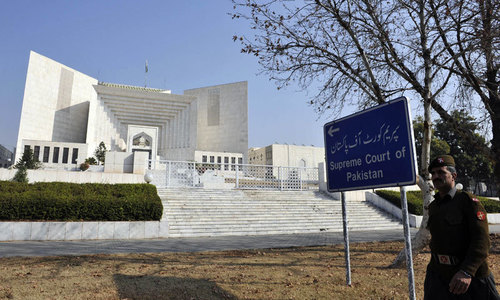
ISLAMABAD: By a majority of two to one, the Supreme Court on Monday rejected a set of petitions seeking review of its Aug 13 verdict relating to Infrastructure Development Cess (GIDC), but asked the federal government to recover the remaining outstanding cess of over Rs400 billion from industries and commercial entities in 60 months instead of 24 instalments.
A three-judge SC bench consisting of Justice Mushir Alam, Justice Faisal Arab and Justice Syed Mansoor Ali Shah had taken up the review petitions moved by different textile, cotton and sugar mills, ceramics companies, chemicals units, CNG filing stations, match factories, cement companies and aluminum industries with a plea to revisit the court’s earlier decision on GIDC.
The Aug 13 judgement had asked the government to recover the arrears in 24 monthly instalments, but Monday’s decision enhanced the period to 60 months.
Earlier, during the hearing, Additional Attorney General Aamir Rehman indicated that the government was inclined to relax the time period for GIDC recovery to 36 months instead of 24 installments.
Makhdoom Ali Khan, the counsel for a number of industrial and commercial entities, argued that there should be a correlation between fee charge and service expenditure and said the government already had Rs135bn in excess since the total cost of the projects to be initiated amounted to Rs160bn, but it had collected Rs295bn.
Moreover, the senior counsel argued, a blanket observation had been made in the Aug 13 judgement that all the industries and business entities had passed on GIDC to their consumers, but factually this was not correct as many of the entities might not have passed on the cess to their customers.
And to determine which company was passing on the cess to the consumers needed factual determination which could only be done at the stage lower than the apex court, the counsel said, emphasising again that the industries had to pay the cess if they passed on this burden to their customers. But if they were not collecting the levy from their customers, they should not be entitled to pay the cess, he said.
The counsel was of the view that the high court concerned should ultimately resolve the matter in case the government claimed that an industrial or commercial entity was collecting cess, but the party disputed the claim.
Another senior counsel Naeem Bokhari argued that GIDC could not be levied on Khyber Pakhtunkhwa which had vast sources of natural gas, adding that imposition of tax without a cabinet decision was illegal.
In its Aug 13 majority judgement, the Supreme Court had ruled that application of GIDC between 2011 and 2015 had accumulated a total amount of Rs700bn, specifically for three pipeline and infrastructure projects, out of which about Rs295bn had already been collected while Rs405bn would be recovered now. Since the cost of these projects was less than Rs700bn, the objective of the cess had legally been achieved and should come to an end at once, it added.
The apex court had also cautioned the federal government that the levying of cess under GIDC would be considered practically dead if work on the laying of three gas pipeline projects was not commenced immediately.
The projects to be launched include the North-South pipeline within six months, TAPI pipeline as soon its laying in Afghanistan reaches the stage where work of laying the pipeline on Pakistan soil can conveniently start and the Iran-Pakistan pipeline as soon as the sanctions on Iran are no more an impediment in its laying.
The judgement had said that in case no work was carried out on the North-South pipeline within the prescribed time and for laying any of the two other major pipelines though the political conditions became conducive, the purpose of levying the cess would be deemed to have been frustrated and the GIDC Act, 2015 would become permanently in-operational and considered dead for all intents and purposes.
The judgement had held that the entire purpose of enacting the GIDC Act was to facilitate import of a very important source of energy i.e. natural gas/LNG from nearby countries to meet the ever-expanding energy needs of the country since indigenous energy resources were fast depleting and the cheapest way to import was through overland transnational pipelines.
On the other hand, Justice Syed Mansoor Ali Shah, in his dissenting note of Aug 13, had asked the federal government to return and refund to the payers in full by constituting a committee to work out a mechanism for refund of GIDC, be it the gas consumers under the Act or the final consumers (people of Pakistan).
Even if the gas consumers had passed on the fee to its customers, technology might be available to credit such customers, so that there was no unjust enrichment on the part of the state, the dissenting note said, adding that the amount of GIDC that could not be refunded after exploring all other avenues would remain earmarked and be utilised only for infrastructure development of the gas sector.
Published in Dawn, November 3rd, 2020