Humanitarian crisis feared as Nagorno-Karabakh ceasefire buckles


YEREVAN: Armenia and Azerbaijan accused each other on Tuesday of violating a ceasefire agreed three days ago to quell fighting over Nagorno-Karabakh, drawing warnings from international groups of a humanitarian crisis in the region.
The Russia-brokered truce is buckling despite mounting calls from world powers to halt the fighting, with US Secretary of State Mike Pompeo and the Minsk Group security watchdog among those urging greater commitment to the ceasefire terms.
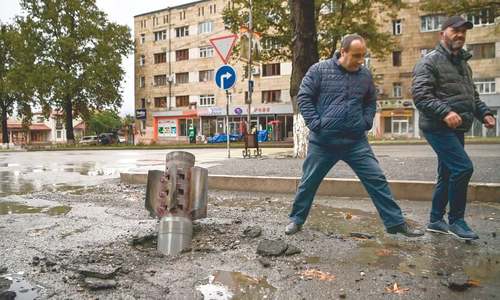
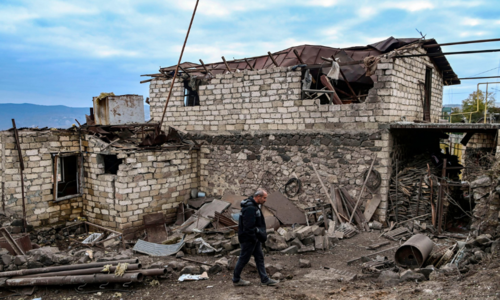
A cameraman witnessed shelling in the town of Martuni in Nagorno-Karabakh, a mountain enclave which is internationally recognised as part of Azerbaijan but governed and populated by ethnic Armenians.
A television crew in Terter in Azerbaijan also said the city centre was being shelled earlier on Tuesday.
Azerbaijan accused Armenian forces of “grossly violating the humanitarian truce”, which was agreed on Saturday to allow the sides to swap prisoners and bodies of those killed.
Defence ministry spokesman Vagif Dargiahly said Armenia was shelling the Azeri territories of Goranboy and Aghdam, as well as Terter. Azeri forces were not violating the truce, he added.
Armenian defence ministry spokeswoman Shushan Stepanyan denied the accusation. She said Azeri forces had resumed military operations after an overnight lull, “supported by active artillery fire in the southern, northern, northeastern and eastern directions”.
The fighting which erupted on Sept 27, is the worst since a 1991-94 war over Nagorno-Karabakh that killed about 30,000.
It is being closely watched abroad, not only due to its proximity to Azeri energy pipelines to Europe but also because of fears that Russia and Turkey could be drawn in.
Russia has a defence pact with Armenia and Turkey is allied with Azerbaijan. The Minsk Group called on the Armenian and Azeri leaders to immediately implement the ceasefire to prevent “catastrophic consequences for the region”.
The 11-member group includes both Russia and Turkey, but the latter is not involved in the Nagorno-Karabakh talks. Turkish Foreign Minister Mevlut Cavusoglu suggested holding talks that would include Turkey.
Ceasefire demands were “reasonable”, according to Cavusoglu, but he said the international community should ask Armenia to withdraw from Azeri territory.
“Sadly no such call is being made,” he told reporters .
Influential Turkish politician Devlet Bahceli, whose party supports President Erdogan’s AKP in parliament, took a more belligerent note, telling Azerbaijan to secure Nagorno-Karabakh by “hitting Armenia over the head over and over again”.
While Turkey denies military involvement in Nagorno-Karabakh, Armenian President Armen Sarkissian told Germany’s Bild newspaper Ankara’s behaviour was worrying.
Published in Dawn, October 14th, 2020