WHILE it is true that the government may not be directly responsible for the arrest of Leader of the Opposition in the National Assembly Shahbaz Sharif, the timing of his detention will surely feed into the opposition’s narrative of persecution and selective accountability.
NAB arrested Mr Sharif after his bail was cancelled by the Lahore High Court. His incarceration a week after the opposition’s multiparty conference had raised political temperatures at a time when the opposition is all set to launch its protest campaign against the PTI government.
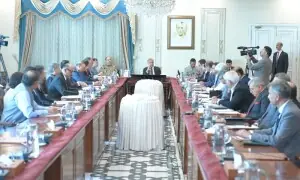
The opposition had also boycotted a meeting convened by the speaker of the National Assembly to discuss elections in Gilgit-Baltistan and the meeting scheduled for Monday had to be cancelled. PPP chairman Bilawal Bhutto-Zardari, while announcing the boycott of the meeting, had said the federal government should not be interfering in the GB elections.
The political situation has become tense since the MPC and the opposition’s announcement of its public campaign. It was less than two weeks ago that leaders of all political parties had attended a meeting with army chief Gen Qamar Bajwa and forged a consensus on giving GB provincial status after the elections scheduled for Nov 15. All leaders had also agreed to ensure that these elections are held in a free and transparent manner. However, this consensus is under strain as evidenced by the opposition’s boycott of the speaker’s meeting. The war of words has once again heated up. Things will get even more acrimonious with the arrest of Mr Sharif.
Pakistani politics is fast turning into a zero-sum game. The PTI leadership continues to call the opposition leadership a ‘mafia’ while the opposition has branded the government as a ‘selected’ one. Neither appears to accept the other’s democratic credentials, and yet both are locked into a system that has to function till the next elections in 2023. It is, therefore, unfortunate that a normal working relationship between key stakeholders is almost non-existent.
After the speech of PML-N leader Nawaz Sharif, it appears that the establishment will also now face a barrage of criticism in the weeks to come. A system in perpetual conflict faces the danger of becoming dysfunctional. Pakistan cannot afford this. The only way to avoid dangerous instability is for the government to provide the opposition the democratic space that its mandate provides it. Fiery rhetoric and inflammatory accusations may suit the government politically but it is ill-suited for a system that is struggling to find stability.
The opposition for its part needs to keep in mind that it also carries the responsibility of ensuring that its protest and planned long march do not push matters to the brink. Personal dislikes should not be allowed to translate into official witch-hunting. All institutions must respect their constitutional limitations and work within the boundaries that have been clearly earmarked.
Published in Dawn, September 29th, 2020