Lebanon’s PM designate bows out after failing to form govt

BEIRUT: Lebanon’s premier-designate stepped down on Saturday, saying he had been unable to form a reform-minded government to lift the country out of its worst economic crisis in decades.
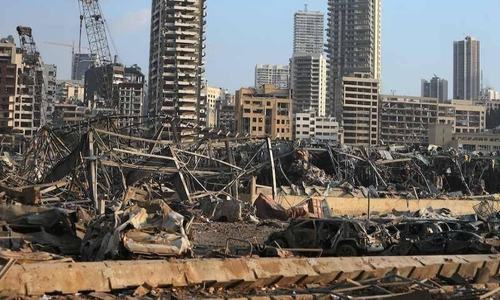
Lebanon’s last government resigned in the aftermath of a colossal blast at Beirut’s port on August 4 that killed more than 190 people, wounded thousands and ravaged swathes of the capital.
Since his nomination on August 31, Mustapha Adib has been under pressure to form a new cabinet as soon as possible to carry out the necessary reforms to unlock billions of dollars in foreign aid.
“I excuse myself from continuing the task of forming the government,” Adib said in a televised speech.
“I apologise to the Lebanese people... for my inability to realise its aspirations for a reformist team,” he said.
Government formation can drag on for months in multi-confessional Lebanon, where a power-sharing agreement seeks to maintain a fragile balance between all sides.
This effectively means that all main political parties must agree on major decisions, including the makeup of any future cabinet even before it is submitted for parliamentary approval.
Adib’s efforts to come up with a new line-up have been effectively blocked by the two main parties representing Lebanon’s large Shia community — Amal and Hezbollah.
The two parties have refused to budge on their demand to keep the finance ministry under their control.
Adib, a little-known 48-year-old former ambassador, was named just hours before French President Emmanuel Macron made his second visit to the country since the August 4 blast, pressing for the speedy formation of a reformist government.
Macron said he had secured commitments from all of Lebanon’s political parties to help Adib achieve that within a fortnight, but the deadline came and went.
The premier-designate said it had become clear he no longer had support from all political forces.
“As the efforts to form a government reached their final phase, it became apparent to me that this consensus... was no longer there and that forming one according to the criteria I had determined was bound to fail,” he said.
Even before last month’s blast, Lebanon was already mired in its worst economic crunch since the 1975-1990 civil war, as it grappled with the novel coronavirus pandemic.
In March, Lebanon for the first time defaulted on its sovereign debt, before launching talks with the International Monetary Fund towards unlocking billions of dollars in aid that then ground to a halt.
The Lebanese pound has plummeted in value, inflation has soared, and poverty rates have doubled to more than half the population.
Adib has become the third prime minister, or prime minister-designate, to step down in less than a year.
Former premier Saad Hariri — who himself quit last autumn, during massive protests — was among several former premiers who on Saturday lamented the deadlock that led to Adib’s resignation.
“You will bite your fingers in regret... over wasting an exceptional opportunity that will be difficult to repeat to stop the economic collapse and put the country on the path of demanded reform,” Hariri said.
UN envoy to Lebanon Jan Kubis reacted on Twitter: “Such a degree of irresponsibility, when the fate of Lebanon and its people is at stake!” “Politicians, have you really scuppered this unique chance created by France?” President Michel Aoun accepted Adib’s resignation and was set to “take the appropriate measures according to the requirements of the constitution”, his office said, adding that the head of state still supported the French initiative.
Just Wednesday, as frustrations grew over the delay in forming a new government, France urged the international community to apply strong and unified pressure on Lebanon.
After the August 4 blast, it emerged the Lebanese authorities had known about the huge stockpile of ammonium nitrate fertiliser that exploded, but had not moved it.
The port blast has rekindled public anger against Lebanon’s entrenched political elite, with protesters accusing politicians across the board of incompetence and corruption.
Published in Dawn, September 27th, 2020