Blasphemy accused gunned down inside courtroom at Peshawar Judicial Complex



An elderly man was killed during the hearing of a blasphemy case against him at the Peshawar Judicial Complex on Wednesday, police told Dawn.
A lawyer, who was present in the courtroom when the incident happened, said that a case had been registered against the deceased under blasphemy laws. The accused was brought to court from Peshawar Central Jail.
"During the hearing of the case, the complainant said that the accused was an Ahmadi and asked him to recite the Kalima-e-Tayyaba," she said, adding that the complainant then fired at the elderly man and killed him.
In a tweet, Jamaat-i-Ahmadiyya Pakistan spokesperson Saleemuddin denied that the deceased was an Ahmadi. "He was born Ahmadi but left the community many years ago," the spokesperson added.
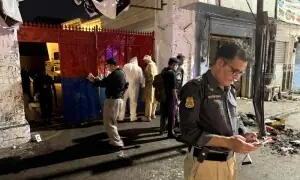
The judicial complex is situated in a high-security zone on the main Khyber Road in the cantonment area where the provincial assembly building, the Peshawar High Court, chief minister's secretariat and Governor House are also situated. Security at the main gate and inside the judicial complex is also high.
Peshawar Capital City Police Officer (CCPO) Mohammad Ali Gandapur and SSP (operations) Mansoor Aman visited the courtroom where the man was killed. Gandapur said the shooter was "arrested on the spot".
"At the moment we have little information but we have started investigation into the killing," the CCPO said. Aman added that the weapon has also been recovered.
A first information report (FIR) was registered against the shooter under Sections 302 (punishment for premeditated murder), Section 7 of the Anti-Terrorism Act (ATA) and Section 15 of the Arms Act on the complaint of a police officer.
Police shifted the body of the deceased, a resident of Board Bazaar, to the Khyber Medical University for post-mortem.
Police said an FIR had been registered against the deceased in 2018. According to the FIR, a copy of which is available with Dawn.com, the complainant alleged that the deceased belonged to the Ahmadi community and "befriended him on Facebook" and in subsequent conversations, claimed that he was the "fourteenth Mujaddid".
"He then invited me to have a discussion with him at a mall in the city where he started talking about his belief," the complainant said in the FIR, going on to make more allegations.
The deceased was charged under Section 153-A (promoting enmity between different groups), section 295-A (deliberate and malicious acts intended to outrage religious feelings of any class by insulting its religion or religious beliefs), Section 295-B (defiling etc. of the Holy Quran), Section 295-C (use of derogatory remarks against Prophet Muhammad PBUH) and Section 298 (uttering words etc., with deliberate intent to wound religious feelings) of the Pakistan Penal Code.