0
0

BEIRUT: Clashes in northwest Syria killed 48 regime fighters and jihadists on Sunday in the highest such death toll since the start of a two-month-old ceasefire there, a monitor said.
A truce since March 6 had largely stemmed fighting in Syria’s last major rebel bastion of Idlib after a months-long regime assault that killed hundreds of civilians and forced almost a million to flee.
But before dawn on Sunday rebels attacked the positions of pro-regime fighters on the western flank of the jihadist-dominated region, the Syrian Observatory for Human Rights.
The clashes in the Sahl al-Ghab area killed 35 regime fighters as well as 13 jihadists including from the Al Qaeda-affiliated Hurras al-Deen group, the Britain-based monitor said.
“It’s the highest death toll for fighters since the truce came into force,” said Observatory chief Rami Abdel Rahman, who relies on sources inside Syria.
“There had been intermittent clashes and mutual bombardment between both sides before, but this is the most violent attack yet.” Abdel Rahman said clashes were ongoing after dark on Sunday night.
The Idlib region of some three million people is dominated by the Hayat Tahrir al-Sham group led by Syria’s former Al Qaeda affiliate, but other jihadists such as Hurras al-Deen and rebel groups are also present.
The truce brokered by regime ally Russia and rebel backer Turkey has kept Syrian and Russian warplanes out of the region’s skies, and largely held despite sporadic clashes or rocket fire. Tens of thousands have returned to their hometowns.
Hundreds of thousands of others remain in crowded displacement camps or in temporary shelters near the Turkish border.
Aid groups have warned that any outbreak of the novel coronavirus there would be devastating.
Syria’s war has killed more than 380,000 people and displaced millions since starting in 2011 with the brutal repression of anti-government protests.
Damascus further rations subsidised petrol
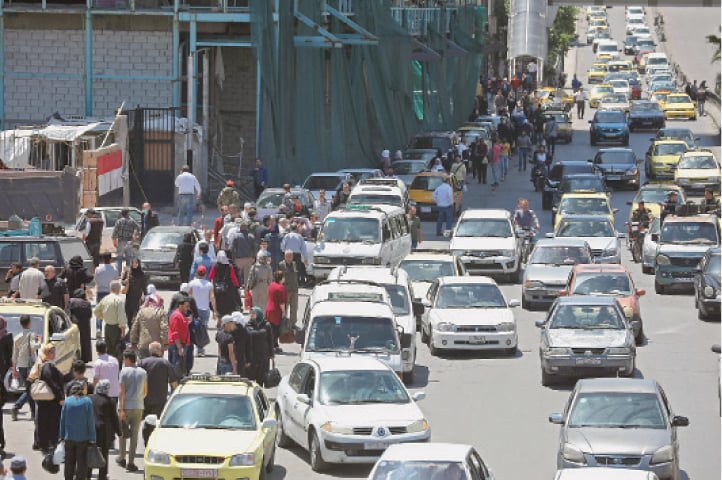
Syria’s government on Sunday banned cars with large engines from receiving subsidised petrol in the latest move to curb a hydrocarbon crisis in the war-torn country the government blames on sanctions.
Heating fuel, petrol and cooking gas have been in short supply over the past two years in government-held areas, with Damascus ordering a series of caps on consumption to try to cope.
Oil and Mineral Resources Minister Ali Ghanem said there would be no more subsidised fuel for cars with engines larger than 2,000 cc as of Sunday.
Individuals or companies with more than one vehicle were also no longer allowed to benefit from the subsidies.
Before these measures, any car owner was entitled to 100 litres of subsidised petrol per month.
With state help, a 20-litre tank refill used to cost 5,000 Syrian pounds (around $7).
Now those hit by the new rations will have to pay 9,000 Syrian pounds (around $12) for the same volume.
Ghanem said the measure “lifted subsidies for only nine percent” of cars, according to state news agency Sana.
“Oil derivatives and crude oil supplied to Syria do no just entail international oil prices, but also the cost of transport and financial transactions as a result of the harsh economic measures” imposed on the government, he said. Damascus has repeatedly blamed the fuel crisis on Western sanctions.
The latest petrol rationing has sparked criticism in the streets and online.
Actress Shukran Murtaja wrote on Facebook: “Can I possibly spend more on my car than on my home? I’ve decided to sell it.” Among dozens who commented on the post, Rami Obeido wrote: “What’s happening is efforts to bring money into state coffers from the pocket of the ordinary citizen.” Ghanem has said Syria needs 146,000 barrels of crude oil per day, whereas it produces just 24,000 locally.
Syria used to produce almost 400,000 barrels per day before civil war broke out in 2011.
But nine years of conflict have ravaged production, and seen US-backed Kurdish-led forces seize control of the largest oil fields in the country.
Syria is in the grips of a severe economic crisis that has seen the value of the local currency plummet to record lows on the black market, and food prices double in a year, according to the World Food Programme.
Published in Dawn, May 11th, 2020