

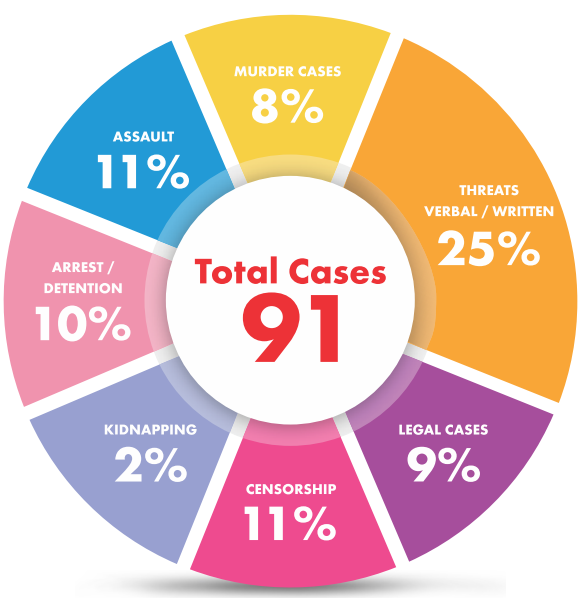
At least 91 cases of violence were recorded against journalists in Pakistan over the past year — which include murder, assault, censorship, threats and legal suits — "signifying a worryingly escalating climate of intimidation and harassment" in the country, said Freedom Network in its annual report released on Thursday.
The Pakistan Press Freedom Report 2019-20, titled “Murders, Harassment and Assault: The Tough Wages of Journalism in Pakistan”, says that between May 2019 and April 2020, an average of over seven cases of violations occurred in a month — one every fourth day, or twice a week.
“The screws on media in Pakistan are being tightened through various means of censorship, including murders, threats, and harassment, resulting in increasing silence and resulting in erosion of public-interest journalism,” said Iqbal Khattak, the executive director of Freedom Network.
Instances of violence
The top three categories of violations against journalists in Pakistan in the period under review included 23 cases of verbal or written threats of murder or other dire consequences (25 per cent), at least 13 cases of offline and online harassment (14pc), and 11 cases of assassination attempts (12pc), of which seven resulted in the killing of journalists.
According to the media watchdog, the violations included killing of seven journalists for their work; two cases of abductions; nine cases of arrests; detentions or confinements; 10 cases of physical assaults, half of which caused severe bodily injuries; one case of attack on the home of a journalist; 23 cases of specific written or verbal threats; 10 cases of censorship, and eight instances of legal cases registered against journalists.
'Riskiest' regions for journalists
According to the findings, while "no place in the four Pakistani provinces or Islamabad [as well as GB and AJK] is safe" for journalists, the federal capital was the "riskiest" territory with 34pc of the cases.
Sindh was the "second worst" with 27pc of incidents of violence, followed by Punjab where 22pc of the cases were recorded.
In Khyber Pakhtunkhwa, 14pc cases of violence against journalists were recorded, while 3pc were recorded from Balochistan.
“The data shows that no place in the four Pakistani provinces or Islamabad is safe — attacks against journalists are taking place everywhere and that shockingly the state and its functionaries have emerged as the principal threat actor wielding the biggest stick to browbeat the media into submission and growing silence,” said Khattak.

Which medium is the most targeted?
The report says that journalists who worked for television were the most vulnerable, as they were identified as a target in 69pc of the cases.
Print media was the second most vulnerable sector as 28pc of the cases of violence were recorded against paper journalists.
Freedom Network recorded three cases of violence against online journalists while no such incident was reported for radio journalists.

'Most serious threat actors'
According to the report, in 42pc of the cases "the victims or their families suspect the involvement of the state and its authorities and functionaries".
Other influential threat actors include political parties, religious groups or criminal gangs and influential individuals, or unidentified threat sources.




























