0
0

“Am I putting my foot down or tap dancing for the man?”
Over the last couple decades, since 9/11 really, there’s been constant cultural conversations revolving round the idea of identity, and what it means to be brown in a western society that, on the one hand, espouses a multicultural, immigrant-friendly attitude and, on the other, rears its ugly Islamophobic head.
This cultural conversation has, for me, become one of the most boring, cynical and toothless discussions possible. This is mainly because the discussion has collapsed into personal experiences, into immigrants’ internal conflicts and their difficulty in ‘fitting in’. It has spawned its own genre of solipsistic migrant literature that often feels like it’s written for white people as a ladder to the moral high ground. Consume this and you get to be one of the good whites who understands immigrant pain.
Ultimately, these solemn meditations about one’s identity, about one’s place in society, end up reading like overly long public therapy sessions, revealing the catharsis to be gained from playing yourself to be a victim. After all, the feeling of ‘not feeling at home’ is a totally universal one, an emotion that everyone can relate to. And that universality ends up dissolving the message into vague conglomerate ‘truths’, something you can put on a pin cushion — ‘home is where the heart is’ — or wins the Richard and Judy Book Prize or whatever.
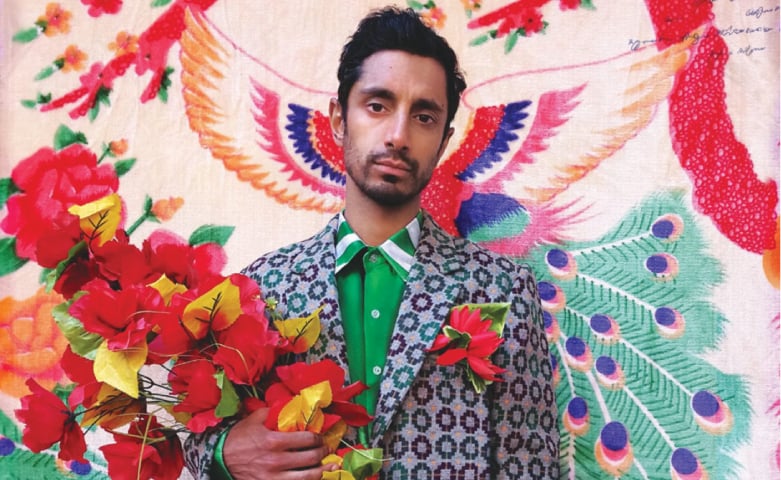
Riz Ahmed’s latest album, The Long Goodbye, is a brilliantly honest and scathing reflection of Brexit Britain
But where Riz Ahmed’s latest album, The Long Goodbye, succeeds is in doing exactly this, but to such a ridiculous extreme it actually somehow works, and ends up being a brilliantly honest and scathing reflection of Brexit Britain.
Using the very literal concept of a break-up album, Ahmed ‘airs his dirty laundry’ in public, as it were, openly discussing his toxic relationship with Britain, here anthropomorphised as a ‘stray pale chick’ called Britney. It’s corny as hell when you first listen to it, and I almost winced from the pun.
But as the album moves forward, Ahmed doubles down on his metaphor — this truly is a break-up album, through and through, and succeeds because of its commitment to the ugliness of the whole affair.
Ahmed has always been willing to take risks. Four Lions, with its black humour and stubborn unwillingness to pander to a white audience, has become an essential artefact for young British Pakistanis, refreshingly counter-cultural in tone. Rubba Dinghy Rapids bro.
Ahmed’s work, as part of the Swet Shop Boys (SSB), was similarly unflinching, using a sharp sense of humour and banging beats to get the message across. On their album Cashmere, being brown was funny and entertaining, self-deprecating but also self-aggrandising. Mostly it was just a blast to listen to.
The Long Goodbye has a far more solemn tone than anything on a SSB record. Riz is more bitter here, using humour sparingly. In the short film released with the album, Ahmed stages a shocking twist (I won’t spoil it) that is extremely hyperbolic, but also striking and powerful.
The album contains a number of tracks dotted with spoken word, voice note interludes. These interludes, voiced by the likes of Mindy Kaling, Hasan Minhaj, Mahershala Ali and more, serve mostly to reinforce the concept of the break-up. Toba Tek Singh, the first real track, references Saadat Hasan Manto’s short story of the same name as a thematic springboard, using the image of Bishan Singh lying in the no-man’s land between India and Pakistan as a metaphor for Brexit Britain.“Stranded I’ll make a stand in one place, I’ll dig my heels in, so what’s my damn name?” raps Ahmed, with more venom in his voice than we’ve heard before.
On Fast Lava, over a relentless banger of a jungle beat, Riz doubles down on the stubborn digging of the heels. ‘This is my house’, he hisses, ‘that’s mine’. Ahmed is totally unapologetic here, blinded by his emotions, and that’s precisely why the album works so well.
Deal With It, my other favourite, uses a groovy South Asian instrumental that’s immediately infectious. Ahmed’s bars here are more akin to a SSB track — there’s the sense of humour and fun present here that’s largely absent from the rest of the track list. But it’s refreshing, a respite from the seriousness that surrounds it.
The finest moment, the most shocking moment for me personally, are the final two tracks. A voice note from Hasan Minhaj informs Riz that he saw his ex at the mall and “she is looking rough!!”
Minhaj continues, unashamedly: “this might sound fucked up, but I’m kind of glad shit’s not going well for her, I feel like it’s karma to be 100 percent honest with you.” The closing track Karma begins to play, with a repeated refrain, ‘that’s karma!’. After the break-up, Ahmed admits to a feeling that we all feel but are perhaps too ashamed to confess: schadenfreude.
That feeling of watching Britain struggle with Brexit, seeing a deal ping-pong through European bureaucracy, watching the Pound slowly devalue. It’s not nice. This is not an emotion anyone is proud of. But a Brexit campaign, that was clearly won on the basis of fear and contempt of the immigrant, to see it blowback in such a way has its own cruel satisfaction. Riz shrugs his shoulders, and just says “that’s karma.”
It’s a moment of searing, brutal honesty from an artist who has never shied away from an ugly truth.
Published in Dawn, ICON, April 19th, 2020