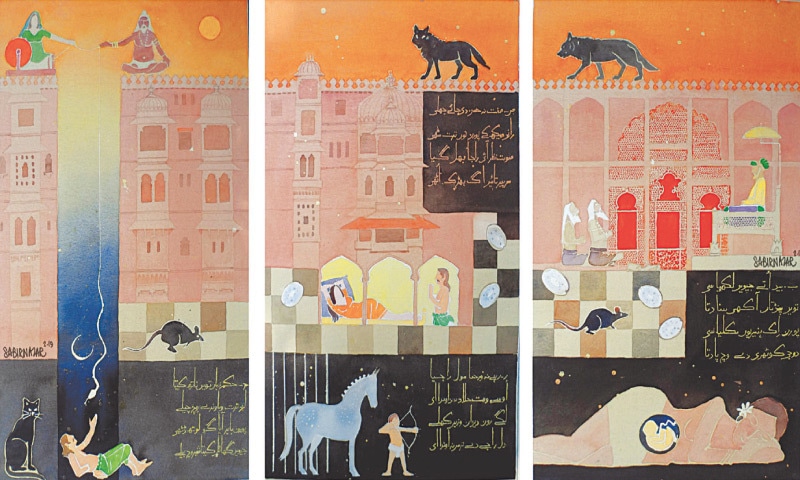

Stories that are passed down from generation to generation often contain a message that is meant to motivate us to become better human beings. Ultimately, stories that fascinate us and leave an indelible mark on our psyche are the ones that transform us, not just because they talk about the triumph of good over evil, but because they teach us to recognise the timeless nature of this struggle.
Perhaps this is why Sabir Nazar’s exhibition of artworks at Maati Gallery stands out. Nazar has a deep interest in history. This is evident in his work as an editorial cartoonist, whose pithy commentary on current events is appreciated. His paintings too talk about history, but in this case folktales form the thematic focus of his content.
Nazar draws inspiration from the pantheon of folktales, religious stories, legends and myths that are evocative of the rich cultural history of the Subcontinent. Yet some of the stories that he has chosen to paint also talk about remembering revolutionary men and mavericks who stood up to tyranny.
For instance, in ‘Ascension of Sarmad Kashana’, a monochromatic drawing built up in layers of cross-hatching, the viewer becomes a witness to the miraculous moment of Shaikh Sarmad’s resurrection from the dead, as he walks up to the steps of the Red Fort in Delhi, carrying his lopped off head in one of his hands. According to legend, Sarmad was executed by Mughal emperor Aurangzeb and, as he walked the fort’s steps, the River Jamuna continued to rise with him till his murshid (teacher) ordered him to stop lest he destroy the city. Sarmad is still revered by both Hindus and Muslims as a figure that stood up to authority for his beliefs.
In another painting depicting the same event, the somber ambience of the drawing is replaced by colour, drama and theatricality. An elephant looks on sternly in the background as Aurangzeb cowers in front of what appears to be Sarmad’s headless body, floating in the angry waters of the rising Jamuna. Two arms clasp Sarmad’s cut-off head, as if holding up a trophy to celebrate his victory in the face of tyranny.
Eminent cartoonist Sabir Nazar in his paintings captures the timeless stories of heroes, martyrs and creation myths
Nazar’s art is inspired by his mother and the theatre performances he saw as a child. “My mother used to tell me stories of Pandavs, Samson and Delilah, Shireen Khusrau, Rustam and Sohrab. Adjacent to our house was a Valmiki Temple, where I saw theatre performance of Kalidas’s Shakuntala and Ramayan, in my childhood years.”
Paintings such as ‘Puran’ are marked by this influence. The design and layout is such that it resembles a tableau-like narration with the text of the story of Puran Bhagat, where each scene unfolds either inside or in the looming presence of a traditional architectural façade of a palace.
The graphical style is accentuated by the presence of animals that appear on the edges of the scenes; they are like silent omens or portents. A black cat, black mice, a unicorn, wolves prowling the roof of the palace under a flaming orange sky; animals become storytellers with their own presence in Nazar’s works.
Nazar uses archetypal images and symbols that draw from the heritage of the region. He says he looks for meanings of objects and their transformation in a montage/placement or an image within an image. His painting ‘Krishna’ is laden with mysticism and colour, but it is the placement of the image within an image that appeals the most.
The picture plane is divided into two parts. The lower and larger portion is dominated by an infant playing a flute inside the stomach of a cow. The presence of a peacock and flowers in the same composition seem to suggest a paradise-like landscape, where flora and fauna are abundant. The upper half shows a yellow leaf ensconced in the womb of a woman lying prone. A snake is shown as a curling tendril, weaving its way down to an infant playing a flute. Is the form of the snake reminiscent of music issuing from Krishna’s flute? Is it an omen of transformation, weaving its way through time?
Nazar’s metaphors urge one to reflect on mythical stories of how the world began and the cosmos itself. The images contain worlds within worlds and their symbolism has a transformative quality as he explains “… when I placed a yellow leaf inside a cow’s udders, it became a symbol of barren land.”
It is this magical quality of being able to bestow new life and meaning to timeless images that exemplifies many of Nazar’s works that stand out in the exhibition.
Sabir Nazar’s paintings were displayed at Maati Gallery in Lahore from March 15 to March 25, 2020
Published in Dawn, EOS, April 5th, 2020