Afghan govt names negotiating team for talks with Taliban

KABUL: The Afghan government has finalised a 21-member team — including five women — who will negotiate with the Taliban in upcoming talks aimed at ending Afghanistan’s 18-year-old conflict, officials said on Friday.
The move is a crucial step in bringing the warring parties to the table and getting a floundering, US-led peace process back on track.
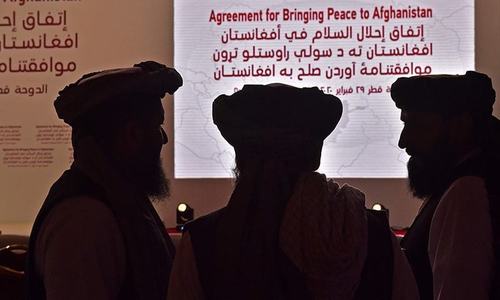
Under a deal signed by the US and the Taliban last month, the insurgents agreed to commit to starting talks with the Afghan government and discuss a possible ceasefire. Earlier, the Taliban had refused to meet representatives of the government, calling President Ashraf Ghani an American stooge.
In return for starting talks and other commitments, the US and foreign partner forces will withdraw from Afghanistan over the next 14 months.
The negotiating team was supposed to be unveiled weeks ago, with the “intra-Afghan” talks with the Taliban meant to get underway on March 10 in Oslo.
But Kabul has been gripped by a fresh political crisis, with Ghani’s legitimacy being challenged by his rival Abdullah Abdullah, who also has proclaimed himself president.
The negotiating team will be led by former Afghan intelligence chief Masoom Stanekzai, who as a Pashtun shares a tribal identity with the Taliban.
While there was no immediate indication of whether Abdullah supports the team’s composition, it includes Batur Dostum, whose father Abdul Rashid Dostum — a notorious former warlord — is a staunch Abdullah ally.
In a statement, Afghanistan’s peace ministry said Ghani “wishes the delegation success and calls on them to consider, at all stages of negotiations, the best interest of the country, the shared values of the Afghan people, and the principle stand of the country for a united Afghanistan”.
Among the five women delegates is Habiba Sarabi, deputy leader of the government’s High Peace Council. Sarabi is a Hazara, the predominantly Shia ethnic group that the Taliban have repeatedly targeted.
Another woman delegate is Fawzia Koofi, an ethnic Tajik and a woman’s rights activist who has been a vocal Taliban critic.
It is not clear when or where the “intra-Afghan” talks will start. Given the coronavirus pandemic, officials say there is a chance they could begin via videoconference.
On Wednesday, the government said its functionaries would meet Taliban members directly to discuss a massive prisoner swap that would see the release of 5,000 Taliban prisoners and 1,000 from the government side.
That exchange had also been agreed in the US-Taliban deal, even though Ghani is not a signatory.
The US has left Ghani little choice but to get on board with the deal, and this week Washington cut $1 billion in aid amid continued bickering between Ghani and Abdullah.
Published in Dawn, March 28th, 2020