



 0
0

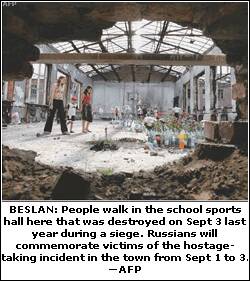 BESLAN: If there is one emotion stronger than Beslan’s grief, it is the town’s fear that its sacrifice was in vain, that Russia has failed to learn from its loss and is wide open to another such tragedy.
Residents of the town in North Ossetia are demanding to know the truth about last September’s school siege in which 331 people were killed, more than half of them children.
They blame incompetent or corrupt officials for allowing a group of Chechen hostage-takers to reach the town along some of the most heavily guarded roads in Russia, and for failing to stop the standoff collapsing into a bloodbath.
Although President Vladimir Putin’s Kremlin has launched investigations and the only surviving hostage-taker, Nurpashi Kulayev, is on trial, bereaved residents say guilty officials have gone unpunished and are still failing to do their jobs.
“Our only aim is to find the truth, so that in the defendant’s cage with Kulayev sit all the others who are to blame, starting with Putin and going on down,” said Zalina Guburova, a member of the “Beslan Mothers” pressure group.
“Only then could we be sure this would never happen again.”
The Beslan siege shocked the world with its images of children running terrified from the school as bullets flew overhead. The standoff ended in a bloodbath after a botched attempt by Russian forces to free more than 1,000 hostages.
Putin launched some political reforms after the tragedy, abolishing regional elections in a drive to strengthen the state against such attacks by Chechen rebels, who have also struck civilian targets in Moscow and elsewhere.
But officials say major changes to the security services will have to wait for the results of two parliamentary investigations — one in North Ossetia, which is in the turbulent Caucasus region, and one in Moscow.
“As a result of the Beslan events, no reforms have been made,” said Stanislav Kesayev, who heads a probe into the tragedy for North Ossetia’s regional government.
He said reforms would only happen after the federal commission in Moscow delivered its report.
“You cannot be sure that something like that will not happen again, but we should be doing all we can to stop it,” he said.
Kesayev has blamed the security services — the police, the firemen, the special forces — for failing to avert the bloodshed or save the hostages in the heavily mined school once the gunbattle started.
Local residents say the area around the school was not secured and that doctors and special forces were not prepared when the bullets started flying.
Few Beslan residents believe the probes will lead to major changes and point to a recent interview by Alexander Torshin, the head of the federal commission investigating the tragedy.
He defended the conduct of local and central governments, the army, security services and individual soldiers.
“The leaders of the security and law-enforcement services had to simultaneously resolve several difficult tasks,” he told Tribuna daily earlier this month.
He said his commission “won’t shield anyone, not the security services, not the local government. But we do not intend to blame anyone irresponsibly. It will just be facts.”
Such caution in apportioning blame is not good enough, said deputy Nikolai Pavlov, a member of the State Duma lower house of parliament’s Security Committee.
“In the (Security) Committee, we have received no proposals from the government to discuss. If you ask whether something like this could happen again, then you have to say there have been no positive changes to stop it,” he said.
Pavlov, a deputy from the nationalist ‘Motherland’ party, said Russia should long ago have learned how to deal with such situations, since Beslan was the fourth major rebel hostage crisis of the 10-year Chechen war. All ended with heavy loss of life.
Chechen guerillas seized a Moscow theatre in 2002 and 129 civilians were killed after Russian forces used gas to knock out the hostage-takers. Doctors said chaos and secrecy during the siege stopped them saving lives.
Hundreds of civilians died in two other sieges in southern Russia in 1995 and 1996.
“A year has gone by and we do not know what to tell our voters about what has been done so such a tragedy does not repeat itself,” said Pavlov, who arrived in Beslan an hour after the siege started on Sept. 1 and saw the chaos first-hand.
“I am convinced that we will have to deal with more than one major terrorist act in the future.”—Reuters



























