India sets free veteran Kashmiri politician Farooq Abdullah


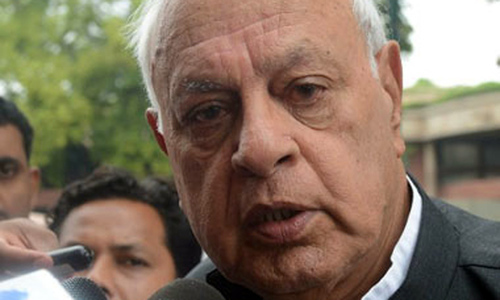
SRINAGAR: Indian authorities on Friday released an influential Kashmiri lawmaker who had been held for seven months after New Delhi stripped India-held Jammu and Kashmir of its semi-autonomy and detained thousands of politicians and activists.
Farooq Abdullah, 82, had been confined to his residence in Srinagar since August 5 when the Indian government split the state and put it under direct New Delhi rule.
An official order said the government was revoking Abdullah’s detention “with immediate effect”, without giving a reason.
Later, the parliamentarian and former state chief minister addressed supporters and thanked those “who fought for my freedom”.
Abdullah, his son Omar Abdullah and several other top Kashmiri politicians were among thousands taken into custody following the clampdown in occupied Kashmir, where an armed rebellion against Indian rule has raged for decades.
The Abdullahs and other politicians were detained under the stringent Public Safety Act, which has been condemned by rights groups because suspects can be held for up to two years without appearing in court.
Police report accuses leader of resorting to ‘dirty politics’
A police report justifying the detention accused the veteran lawmaker of resorting to “dirty politics” and “instigating and provoking general masses” against the Indian government.
Omar Abdullah, also a former chief minister, and hundreds of others remain in detention, many outside the disputed territory and in Indian states.
New Delhi locked down the occupied region following the August move, bringing in tens of thousands of troops into the already heavily militarised territory.
Restricted internet access was allowed in late January after a blackout lasting almost six months.
The security lockdown and detentions have drawn international criticism including by the European Union and the United States.
Kashmiri groups have fought for decades for the Himalayan region’s independence or its merger with Pakistan. The fighting has left tens of thousands dead since 1989, mostly civilians.
Published in Dawn, March 14th, 2020