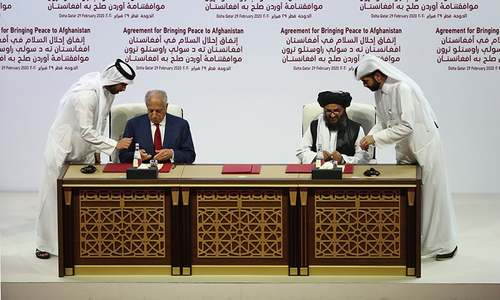
WITH the signing of the peace deal between the US and the Afghan Taliban in Doha yesterday, America’s long war in Afghanistan may be coming to a close.
America’s envoy for Afghanistan Zalmay Khalilzad and the Taliban’s representative Mullah Abdul Ghani Baradar were all smiles while signing the deal in the Qatari capital. But the days ahead will show whether these cordialities are genuine, or if the once-bitter foes return to face each other on the battlefield.
There are quite a few unanswered questions emerging from the Doha process, as well as some lessons that should be learnt by all sides.
If everything goes according to plan, Afghanistan’s long nightmare may indeed soon give way to a more peaceful future.
However, knowing that country’s history, it is too early to celebrate, though one should remain optimistic considering that the alternative to dialogue is relentless war.
And over the past four decades, Afghanistan has been battered by more than its fair share of conflict, as a result of foreign meddling as well as its own political elite’s lust for power.
The Americans and their Nato allies have agreed to withdraw all foreign troops within 14 months, while the Taliban have consented to talk to the US-backed government in Kabul — a dispensation they have in the past dismissed and derided.
Moreover, the Taliban have also agreed to not host Al Qaeda, a former ally, or any other terrorist outfit in any of the areas the militia controls. This can only be welcomed.
On paper these are all positive developments, though it will be up to the stakeholders — primarily all Afghan factions, the Americans, as well as neighbouring states — to help this difficult but doable peace process succeed.
One of the main lessons that should be learnt from the Afghan imbroglio is the failure of nation-building projects by foreign forces.
While the US invaded Afghanistan in the aftermath of 9/11 — as the Taliban were hosting Al Qaeda at the time — this mission quickly turned into a more complicated ‘civilising’ project, as the Americans sought to remake the country in their own image, without realising the tribal and ethnic complexities of Afghanistan.
Similar tales of disaster have emerged in Iraq, Libya and Syria, where the US and other Western forces have toyed with regime change, with horrific results.
Secondly, the government in Kabul must accept the Taliban as a political reality, even though both sides despise each other at the moment.
The fact is that unless Afghans trust each other and work together, no foreign-backed peace initiative will succeed, as the Mujahideen infighting after the Soviet withdrawal showed. And the Taliban must also pledge to respect the political process and work within democratic norms if they wish to see peace prevail in their homeland.
Published in Dawn, March 1st, 2020