Pakistan hails Doha Accord as harbinger of peace in Afghanistan



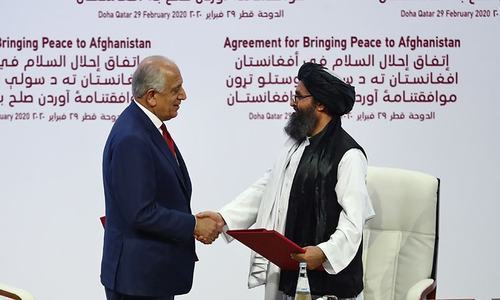
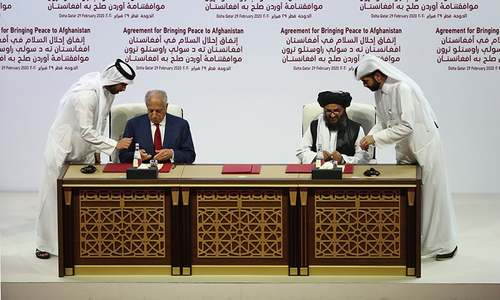
ISLAMABAD: Pakistan on Saturday welcomed the signing of Doha Accord between the United States and Taliban as a major step towards peace in Afghanistan after 19 years of war and hoped that Afghan factions would avail this opportunity to reach a mutual accommodation.
Pakistan was represented at the signing ceremony in the Qatar capital by Foreign Minister Shah Mehmood Qureshi. The agreement, under which the US committed to withdraw up to 5,000 troops in about four and a half months and all remaining forces within 14 months, if the deal holds, is expected to lead to initiation of intra-Afghan dialogue by March 10.
“We welcome the Doha Accord signed between US and the Taliban. This is the start of a peace and reconciliation process to end decades of war and suffering of the Afghan people,” Prime Minister Imran Khan tweeted and said he stood vindicated that a political solution was the only route to peace.
Cautioning about the challenges ahead for the peace process, Mr Khan said: “Now all stakeholders have to ensure that spoilers are kept at bay. My prayers for peace for the Afghan people who have suffered 4 decades of bloodshed.”
FM hopes Afghan parties will work out an inclusive political settlement for durable peace, stability
Pakistan, which played a key role in US-Taliban negotiations that resulted in the signing of the accord, the prime minister said, remained committed to playing its role in ensuring that the agreement held and succeeded in bringing peace to Afghanistan.
Meanwhile, Foreign Minister Qureshi after witnessing the signing ceremony said that Doha Accord was important, both in symbolism and substance, for Afghanistan, the region and beyond. “It is a significant step forward by US and Taliban in advancing the ultimate aim of peace and reconciliation in Afghanistan,” he maintained.
Mr Qureshi hoped that the Afghan parties would now seize this historic opportunity and work out a comprehensive and inclusive political settlement for durable peace and stability in Afghanistan and the region.
He underlined the need for continued international support for Afghanistan to enable it to commence reconstruction and rehabilitation phase. He further called for assisting the Afghan government in creating an enabling environment for the return of the refugees.
About Pakistan’s policy towards Afghan peace process, the foreign minister recalled that Pakistan had fulfilled its part of the responsibility for facilitating the peace agreement and would continue supporting the Afghan people in their efforts to achieve lasting peace, stability and development in their country.
“Pakistan will continue to support a peaceful, stable, united, democratic and prosperous Afghanistan, at peace with itself and with its neighbours,” he asserted.
National Assembly Speaker Asad Qaiser said that Pakistan had always been a staunch supporter of resolution of disputes through peaceful means. He said that sustainable peace and security in Afghanistan, which would ensure long-term development, progress and prosperity there and in the region was in Pakistan’s best national interest. Peace, he believed, would also allow Afghan refugees to return to their homeland.
Reaffirming Pakistan’s resolve and continued commitment to the Afghan peace process, the speaker said a national dialogue was being convened on March 17 to look into the challenges arising out of the post US-Taliban accord situation with specific reference to Pakistan. Representatives of political parties, parliamentarians, academia, intelligentsia, media and civil society would be invited to attend the session.
Published in Dawn, March 1st, 2020