IHC summons magistrate for including sedition charges against 'peaceful' protesters

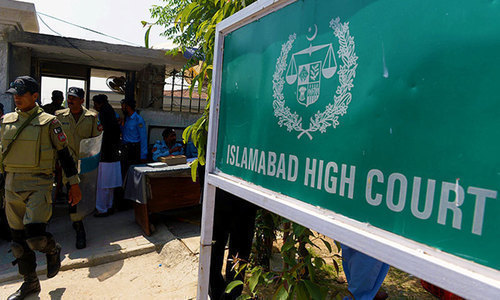
The Islamabad High Court on Tuesday demanded an explanation from an Islamabad city magistrate for including sedition charges in the first-information report (FIR) registered against the 23 activists who had been detained for protesting outside the press club against the arrest of Pashtun Tahafuz Movement (PTM) leader Manzoor Pashteen.
During the hearing today, IHC Chief Justice Athar Minallah was told that Islamabad City Magistrate Ghulam Murtaza Chandio ordered for the FIR to be registered against the 23 individuals, which included activists from the Awami Workers Party (AWP) and PTM.
"What is this? How can you first place sedition charges on peaceful protesters and later turn them into terrorism charges?" Justice Minallah questioned.
The court was informed today that terrorism charges had also been dropped from the FIR against the protesters.
"Today you are saying that the terrorism charges have also been dropped," the IHC chief justice noted.
"Why should we not start proceedings against the one who asked for the case to be registered? The magistrate should appear in court and tell us why he gave such orders," Justice Minallah said.
The judge then proceeded to order that the magistrate provide the court his explanation along with a sworn affidavit.
"How about we take away judicial powers from the magistrate?" the chief justice remarked, while once again summoning the Islamabad chief commissioner and police chief to court in the next hearing.
"We will turn this case into an example for everyone," the IHC chief justice said, as he adjourned the hearing till February 17.
In the last hearing, the Islamabad deputy commissioner and deputy inspector general of police had informed the court that Section 124-A (sedition) of the Pakistan Penal Code had been replaced with Section 7 of the Anti-Terrorism Act (ATA), 1997, in the FIR.
The court had, at that time, granted post-arrest bail to the activists, and asked for a report on why sedition charges were added to the FIR.
The court's written orders of bail said: "A plain reading of the FIR shows that the offences mentioned therein are, prima facie, not attracted. There is also no material on the record in support of the assertions made in the FIR."
It was further observed in the order that Additional District and Sessions Judge Mohammad Sohail — who had earlier declined to grant post-arrest bail to the activists by saying that prima facie it was a terrorism case — "appears to have exceeded jurisdiction by making observations [regarding terrorism ...] without having regard to the recently enunciated law by the august Supreme Court regarding scope of the Anti-Terrorism Act, 1997".
"Moreover, the observations recorded by the learned judge are not in consonance with the principles of fair trial," the order had said.
The Islamabad press club protests were held a day after Pashteen was arrested on January 27 from Peshawar's Shaheen Town and sent to Peshawar Central Jail on a 14-day judicial remand by a magistrate.
A day after his arrest, a Peshawar court had rejected the PTM leader's bail plea and ordered his transfer to Dera Ismail Khan, where he is currently imprisoned.
On February 8, a Dera Ismail Khan court granted Pashteen bail in two cases, while his bail applications in two other cases are pending before the court.
PTM movement
PTM is a rights-based alliance that, besides calling for the de-mining of the former tribal areas and greater freedom of movement in the latter, has insisted on an end to the practices of extrajudicial killings, enforced disappearances and unlawful detentions, and for their practitioners to be held to account within a truth and reconciliation framework.
The party has been critical of the state's policies in the country's tribal belt, where a massive operation against terrorists was conducted in recent times leading to large-scale displacement and enforced disappearances.
PTM's leaders, in particular its elected members to the National Assembly, have come under fire for pursuing the release of individuals detained by authorities without due process. The army alleges the party of running an anti-national agenda and for playing into the hands of the state's enemies.
The Islamabad press club protest was where Dawar was arrested by police during a public gathering for a second time. Last year, he and Wazir were arrested after a protest gathering in Kharqamar for allegedly using violence and clashing with army personnel. The party while rejecting these allegations, insisted that theirs is a peaceful struggle for the rights of people from the country's tribal belt.