1
1


BERLIN: German Chancellor Angela Merkel’s party and her plans to stay on until 2021 were plunged into disarray on Monday after her heir-apparent gave up her leadership ambitions in a deepening crisis over ties between the centre and far right.
Annegret Kramp-Karrenbauer, the leader of the centre-right Christian Democratic Union (CDU), opted out after barely a year in the post — a period marked by internal battles over whether to cooperate with the anti-immigrant Alternative for Germany (AfD).
She announced that she was standing down as CDU leader and would not seek to be the party’s candidate for chancellor in next year’s general elections.
“This is an unusually serious situation for the CDU,” said close Merkel ally and Economy Minister Peter Altmaier.
AKK, as Kramp-Karrenbauer is popularly known, said she had had “a difficult time” as party leader.
“At present, we can feel powerful centrifugal forces in our society and in our party,” she told reporters in Berlin.
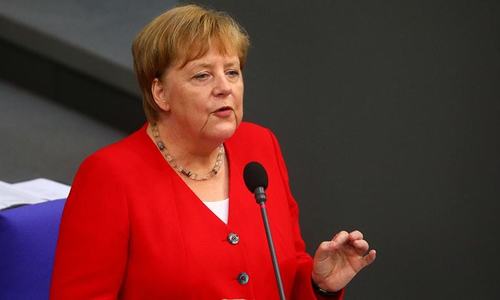
Speaking later in Berlin, Merkel said she “regrets” AKK’s departure, at one point calling her simply “Annegret” in a rare personal moment in front of the cameras.
While the party has a policy of no cooperation with either far left or far right at a national level, regional CDU lawmakers last week went rogue and voted with MPs from the AfD to oust a far-left state premier in Thuringia.
The breach in the political firewall against the AfD prompted Merkel’s junior partners in the national government, the Social Democratic Party (SPD), to call urgent talks at the weekend about the partnership’s future.
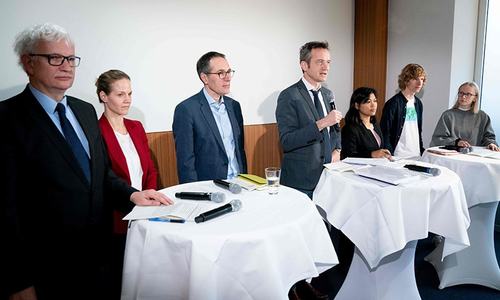
“The CDU must clarify its relationship to far-right extremists,” SPD co-leader Norbert Walter-Borjans told a press conference on Monday.
Centre-left SPD ministers will not work with a party “that leaves room for far-right forces,” he added.
With the race to the chancellery wide open again, Sueddeutsche Zeitung said the aftershocks could be huge. “It’s very possible that the chancellor’s exit is coming closer,” it wrote.
Voting alongside the far right breaches one of the fundamental taboos of post-World War II German politics -- the refusal of mainstream parties to work with the extremes.
AKK’s attempts to impose rigid no-cooperation discipline from Berlin have foundered especially in Germany’s former communist east, where strong showings for the AfD and Left in some states threaten the ability of mainstream parties to form functioning coalition majorities.
Germany’s next national elections must take place by autumn next year, although the fractious coalition between the CDU, its Bavarian CSU allies and the SPD may not hold until then. AKK however said she did not believe her retreat would endanger “the stability of the grand coalition government”.
Published in Dawn, February 11th, 2020