BAKU: Polls closed on Sunday in Azerbaijan’s snap parliamentary election which were decried by the opposition as a sham while international observers said the polls were "well organised".
Faced with public discontent over a slowing economy President Ilham Aliyev, 58, hoped to improve the government’s image by holding early elections and replacing discredited old elites with younger technocrats, critics said.
Aliyev’s Yeni (New) Azerbaijan party promised that the election would be democratic, but the opposition accused the government of limiting their ability to campaign and several parties have boycotted the vote.
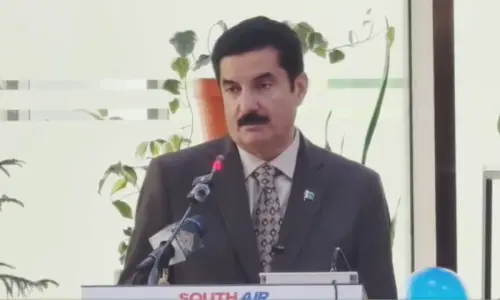
Meanwhile, Director General of the Islamabad-based Center for Global and Strategic Studies Khalid Taimur Akram said the polls were "well organised".
According to DNANews, Akram expressed his confidence that the newly-elected Azerbaijani parliament "will do its utmost for Azerbaijan’s development and prosperity".
Following the polls, Russian MP Maksim Ivanov said: "The positive changes that are taking place in Azerbaijan are clearly visible," Centreline reported.
Additionally, MP Ludmila Kozlova said that many observers and journalists were present at the start of the elections and there had been no incidents at polling stations.
A German observer said he was "touched by the participation of voters from Nagorno Karabakh," Centreline reported.
Matthias Dornfeld said the Nagorno-Karabakh conflict should be resolved with the assistance of the OSCE Minsk Group as well as other international organisations
The mountainous, ethnic Armenian area of about 150,000 people is recognised as part of Azerbaijan in UN Security Council resolutions dating to the 1990s. But Nagorno-Karabakh and some neighbouring districts have been under the control of local ethnic Armenian forces, backed by Armenia, since a six-year separatist war ended in 1994.
More than 5.3 million people were eligible to vote in the snap parliamentary elections. Turnout stood at nearly 45 per cent as of 1300 GMT, two hours before polls closed, said the central election commission.
Parliamentary elections had originally been scheduled for November this year, but in December 2019 Aliyev called early polls after a surprise self-dissolution of the legislature that is dominated by his ruling party.
The move followed a replacement of the prime minister and a number of veteran officials within the presidential administration and the government.
Aliyev’s party, which faces little challenge from the embattled opposition, is expected to retain its majority in the legislature.
Analyst Anar Mammadli noted that public anger over economic problems has been growing in the South Caucasus country of nine million people.
“Aliyev chose to hold elections eight months ahead of schedule as he fears that protest sentiment would grow further by November,” he said.
Highly dependent on energy exports, the country has since 2015 been hit by a drop in energy prices and the global economic downturn, and has sharply devalued its currency, the manat.
With most powers concentrated in the presidency, parliament has a limited role in the Caspian nation’s political system.
“There aren’t even minimal conditions in Azerbaijan for holding democratic elections,” said Ali Karimli, leader of the opposition Popular Front party which is boycotting the polls. “There will be an imitation of an election in Azerbaijan,” he said ahead of the vote.
Electoral commissions are controlled by Aliyev’s party and all of the oil-rich country’s television stations have refused to allocate airtime to representatives of the opposition.
Prior to this, none of the elections held in Azerbaijan since Aliyev came to power have been recognised as free and fair by international observers.
Aliyev has ruled the ex-Soviet state with an iron fist since he was first elected in 2003, after the death of his father, Azerbaijan’s Soviet-era Communist leader and former KGB general Heydar Aliyev.
Under the Aliyev dynasty, Baku has faced strong international criticism for persecuting political opponents and suffocating independent media.
Published in Dawn, February 10th, 2020