India's Republic Day celebrations marked with protests, blasts


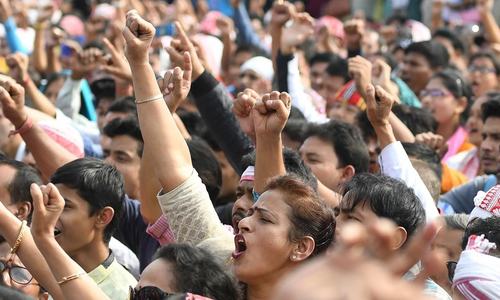
Hundreds of thousands of Indians protested across the country on Sunday against a citizenship law that many fear is discriminatory against the minority Muslim community.
The protests, which began last month, gathered fresh momentum as India celebrated Republic Day, in commemoration of the day the Indian constitution came into effect.
In the southern state of Kerala, organisers said more than a hundred thousand people formed a human chain. It was followed by public meetings at over 250 places across the state.
Explainer: What does India's new citizenship law mean?
"It was not a mere human chain, but a human wall against the violation of the principles of the Constitution," said Kerala's Chief Minister Pinarayi Vijayan, addressing a public meeting in the state capital of Thiruvananthapuram. Another human chain spread over 11 kilometres was also formed in Kolkata, organisers said.
The Citizenship Amendment Act (CAA) and the National Citizens Register (NRC) were a key part of the election manifesto of Prime Minister Narendra Modi's ruling Hindu nationalist party.
The government believes the legislation is needed to protect refugees across South Asia. The CAA aims to fast-track citizenship for persecuted Hindus, Parsis, Sikhs, Buddhists, Jains and Christians who arrived in India before December 31, 2014, from Muslim-majority Afghanistan, Bangladesh and Pakistan.
Clashes between protesters and police leaving at least 25 dead have been a regular occurrence since Dec 12, when the government passed the legislation.
Tens of thousands protested in India's financial hub of Mumbai, as well as Lucknow, the capital of populous Uttar Pradesh state which has seen the highest number of deaths since the unrest began. Both were predominantly female-led.
“Our protest against this discriminatory citizenship act ... will continue until it is withdrawn by the government,” said Ambreen Rizvi, a female protester in Lucknow.
The northeastern state of Assam witnessed five low-intensity explosions for which the United Liberation Front of Assam (ULFA), a militant group, has taken responsibility. No casualties were reported.
In New Delhi, the government hosted the annual Republic Day parade aimed at showcasing India's military hardware and cultural diversity. Brazil's president Jair Bolsonaro was the chief guest.
Protesters also gathered in the capital, including in the area of Shaheen Bagh, where hundreds of residents have blocked a major highway since December.
A women-only led rally with over 20,000 protesters also gathered in a suburb in Mumbai to mark their dissent against the new law.