Hasina, Karzai join criticism of Indian citizenship law



NEW DELHI: Bangladesh and Afghanistan have opposed India’s controversial law — the Citizenship Amendment Act (CAA) — which cites the two together with Pakistan as the three neighbours that discriminate against non-Muslim minorities.
Former Afghan President Hamid Karzai told The Hindu that the law which excludes Muslims and woos Hindus, Sikhs, Jains, Buddhists, Christians and Parsis from the three countries for citizenship rights should be extended to everyone equally.
“We don’t have persecuted minorities in Afghanistan… the whole country is persecuted. We have been in war and conflict for a long time. All religions in Afghanistan — Muslims and Hindus and Sikhs — which are our three main religions, have suffered,” Mr Karzai said.
He was speaking to The Hindu during a visit to Delhi where he addressed the inaugural session of the government’s Raisina Dialogue. Mr Karzai said he hoped the sentiment that minorities must be protected “would be reflected in India with regard to other Afghans, who are Muslim, as well.”
Mr Karzai’s comments, differing from New Delhi’s view are significant, given that he has been seen as a strong friend of India. Like many Afghan leaders, Mr Karzai has also lived in India for several years beginning in 1976, and has studied in Shimla.
In December, India’s foreign ministry had clarified that the CAA referred to past attacks against minorities in Afghanistan and that the current government had “substantially addressed the concerns of the minority communities as per their constitutional provisions.”
Bangladesh Prime Minister Sheikh Hasina, seen as a key regional ally of India’s rightwing Hindu revivalist government, criticised the new law in an interview with Dubai’s Gulf News, saying the new law was not necessary.
Ms Hasina said Prime Minister Narendra Modi had personally assured her that a related new measure — the National Register of Citizens (NRC) — was an internal matter of India that would not affect her people. But the NRC is being implemented in Assam, and is proposed to be extended across the country, with a view to sending back alleged illegal Bangladeshi migrants to their country.
Home Minister Amit Shah has said the proposed countrywide NRC would be used to evict Muslim “termites”.
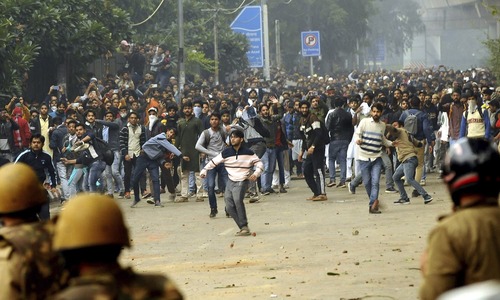
“We don’t understand why (the Indian government) did it. It was not necessary,” Ms Hasina told Gulf News in Abu Dhabi where she held high-level meetings. The statement is the first by the Bangladesh leader since the disputed law, that has triggered protests across India, was cleared by the Rajya Sabha on Dec 11.
During the parliamentary debates, Home Minister Amit Shah repeatedly referred to persecution faced by minority communities, mainly the Hindus, in Afghanistan, Bangladesh and Pakistan arguing that these groups should get citizenship rights in India. Ms Hasina distanced her country from the line taken by the Indian government.
“It is an internal affair. Bangladesh has always maintained that the CAA and NRC are internal matters of India. The government of India, on their part, has also repeatedly maintained that the NRC is an internal exercise of India, and Prime Minister Narendra Modi has in person assured me of the same during my visit to New Delhi in October 2019,” she said.
Ms Hasina’s government has said that minority communities did not leave her country because of persecution and maintained that there is no reverse migration from India either. “But within India, people are facing many problems,” she declared.
Published in Dawn, January 20th, 2020