China launches rocket in boost for 2020 Mars mission


 1
1
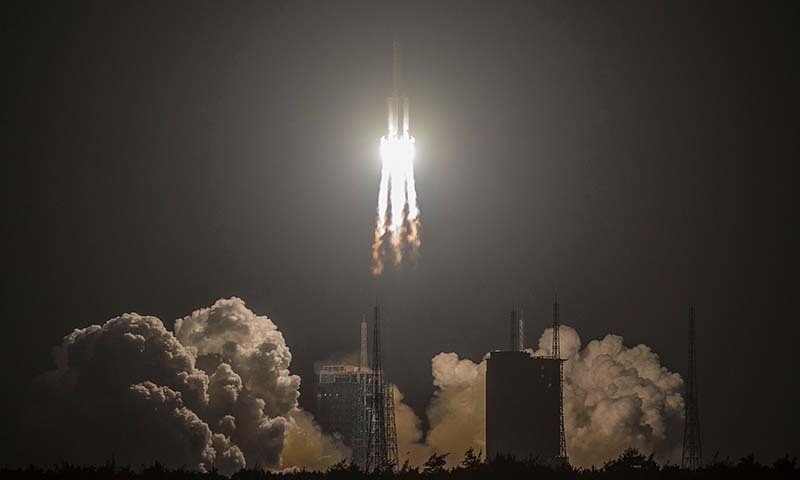

BEIJING: China on Friday launched one of the world’s most powerful rockets in a major step forward for its planned mission to Mars in 2020.
The heavy lift Long March 5 rocket carrying a Shijian 20 test satellite payload blasted off from the Wenchang launch site on the southern island of Hainan at 8:45pm, a livestream from state broadcaster CCTV showed.
“After more than 2,000 seconds, the Shijian 20 satellite was sent into its predetermined orbit,” the official Xinhua news agency reported.
The rocket launch “tests key technologies related to future space missions,” Xinhua said.
The successful launch is a key part of China’s ambitious plans for a mission to the Red Planet next year and hopes of having a crewed space station by 2022.
“The Long March 5 rocket is tasked with important missions,” Wu Yanhua, the deputy head of China’s National Space Administration, said in a video released by CCTV last week.
“It will be tasked with a series of key missions including launching China’s first Mars probe, the Chang’e-5 lunar probe and a core module for the manned space station.” More than a million people watched an online livestream of the launch and crowds gathered near the island launch site cheered as the rocket blasted off into the night sky, videos posted on social media showed.
“Fat Five,” the rocket’s nickname, was a trending topic on the Twitter-like Weibo social media platform.
Friday’s success gets the space programme back on track after a previous attempt in July 2017 failed mid-launch.
The Long March 5 Y2 was supposed to put the Shijian 18 experimental communications satellite into orbit and its failure delayed plans to use the rocket in a planned mission to collect lunar samples in the second half of 2017.
China successfully launched the first Long March 5 in November 2016, which it said at the time was the most powerful launcher it had yet developed.
The Long March 5, which is capable of carrying up to 25 tonnes, is comparable in capacity to the US-made Delta IV Heavy and Russia’s Proton-M, some of the most powerful launchers in existence, according to NASA SpaceFlight.com.
By contrast the US’s Saturn V, which delivered astronauts to the Moon in 1969, was designed to deliver some 140 tonnes of payload into low Earth orbit.
Beijing has invested billions of dollars in its space programme in an effort to catch up with its rival, the United States, and affirm its status as a major world power.
Published in Dawn, December 28th, 2019